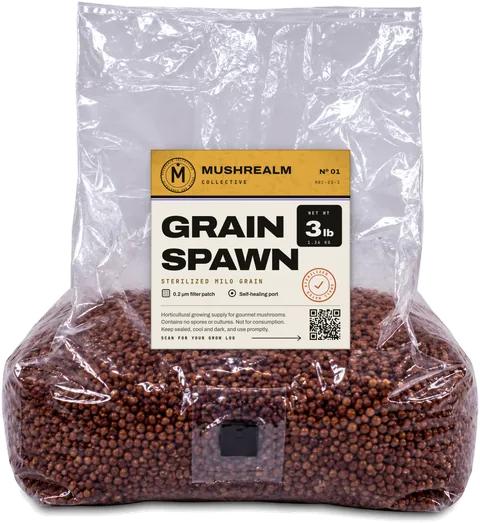
Our US bench runs sterilized milo (sorghum). Our UK bench runs sterilized whole oats. Which one is better is one of the questions we hear most, and the honest answer is that both make excellent spawn and every common gourmet species grows on either. We chose milo for the US because it is clean, cheap, consistent and hard to ruin, and it is the grain American feed stores carry in bulk. Here is how the two compare, milo first.
Why our US bench uses milo
Milo is grain sorghum, a small, round grain grown widely across the US Great Plains and sold everywhere as livestock feed and bird seed. That matters more than it sounds: a staple feed crop is easy to buy clean, consistent and in bulk, batch after batch.
On the bench, milo earns its place for three reasons:
- It resists splitting. The hard seed coat keeps kernels intact through hydration and sterilization, so there are very few burst, sticky kernels to clump together or feed bacteria.
- It gives lots of inoculation points. Milo kernels are small, so a kilo holds far more of them than a kilo of oats. More kernels means more starting points when you mix the spawn into bulk substrate.
- It breaks apart cleanly. Colonized milo crumbles into loose, individual kernels, which makes the break and shake and the final mix into substrate quick and even.
Its weakness is hydration speed. That hard seed coat takes water slowly, so milo needs a longer soak and simmer than oats. If you buy it pre-sterilized, that part is already done.
Why our UK bench uses whole oats
Whole oats, still in their husk, are the standard horse and farm feed grain in the UK, sold by the sack by feed merchants and country stores. Milo is not a common crop in the UK and mostly turns up in small quantities in pigeon and bird feed, where it is called "dari", often mixed with other seeds. For a bench that needs the same clean grain every week, oats are the obvious choice.
They also behave well in the bag:
- The husk protects the kernel. It works like a jacket, helping the oat hold water without splitting. Whole oats are much more forgiving than dehulled oat groats.
- They hydrate quickly and evenly. Oats take water faster than milo, which makes them easier to get right if you prepare your own.
- They colonize and spread well. Each kernel is bigger than a milo kernel, so there are fewer per kilo, but still plenty for an even mix into coir and vermiculite.
The trade-off is that fewer, larger kernels give fewer inoculation points per kilo than milo. In practice you make up for it with a generous spawn rate and a thorough break and shake.
Side by side: the practical differences
| Milo (sorghum) | Whole oats | |
|---|---|---|
| What it is | Grain sorghum with a hard seed coat | Oat kernel still in its husk |
| Kernel | Small and round, a few millimeters across | Long and slim, around a centimeter with the husk |
| Kernels per kilo | Many more | Fewer |
| Hydration | Slow; needs a long soak and simmer | Faster and more even |
| Splitting risk | Low | Low to medium (higher for dehulled groats) |
| After colonization | Crumbles into loose kernels | Breaks into small clumps that loosen with a little more massaging |
| Spread through bulk substrate | Very even, many small points | Even, slightly chunkier |
| Easiest to buy in | The US: feed stores and bird seed | The UK: horse and farm feed |
What the difference means when you grow
Inoculating. No difference. Both bags take a liquid inoculant through the self-healing injection port, or a grain transfer, in exactly the same way.
Break and shake. Both benefit from one break and shake when roughly a quarter of the grain is white. Milo's small round kernels loosen into a free-flowing mix. Oats tend to hold together in small clumps, so give the bag a slightly firmer massage to separate them.
Spawning to bulk. The same weight of milo spreads into more starting points than oats, so it reaches an even spread a little more easily. With oats, keep the spawn rate generous and break the block up well. Our kits pair grain and substrate at about 1 : 2 by weight with either grain, and that rate colonizes CV Prime quickly.
Spawning sawdust or logs. Smaller kernels distribute more evenly through sawdust, which gives milo a slight edge for wood-loving species. Oats still work well.
Which species like which?
Honestly, there is no common gourmet species that clearly needs one of these grains over the other. Differences in speed between milo and oats are small next to temperature, inoculation rate and hydration. Here is what matters more for each group:
| Species | Milo or oats? | What matters more |
|---|---|---|
| Pearl, blue and golden oyster | Either | Fast on both; 21 to 24°C (70 to 75°F), golden a little warmer |
| Pink oyster | Either | Wants warmth, 24 to 29°C (75 to 85°F); never refrigerate the spawn |
| King oyster | Either | Slower than other oysters on any grain; be patient |
| Lion's mane | Either | Thin, wispy growth looks sparse on both, and that is normal |
| Shiitake, maitake, reishi | Either (milo slightly better for sawdust) | They fruit best on supplemented hardwood sawdust, which we do not sell; grain spawn is how you inoculate it |
For more on each oyster, see our guide to oyster mushroom varieties, and for the slower species, the lion's mane guide.
Can you switch or mix them?
Yes, with one caution. A grain-to-grain transfer from a colonized milo bag into fresh oats, or the other way round, works fine. Mycelium does not care which grain it came from.
If you prepare your own grain, though, do not mix milo and oats in the same batch. They hydrate at different rates, so you end up with underdone milo or overdone oats. And do not expect a change of grain to fix contamination problems. Those come from hydration, sterilization and technique. Our comparison of the best grains for mushroom spawn covers rye, millet and the rest.
Which should you choose?
In the US, choose milo. It is the cheapest clean grain you can buy here, it is hard to ruin, and it gives you more inoculation points per pound. Our grain spawn is sterilized milo in 1.4 kg (3 lb) bags at $15 and 2.3 kg (5 lb) bags at $27. If you prepare your own and find milo slow to hydrate, whole oats from a feed store are a fine alternative.
Either way, the grain arrives hydrated and pressure sterilized in a bag with a 0.2 micron filter patch and a self-healing injection port. For timelines once it is inoculated, see how long grain spawn takes to colonize.
The short version
- Milo and whole oats both make excellent spawn for every common gourmet species.
- Milo: small, hard kernels, low splitting risk, more inoculation points, slow to hydrate. Cheap and everywhere in the US.
- Oats: husk-protected kernels, quick even hydration, fewer but larger kernels. Cheap and everywhere in the UK.
- Grain choice changes handling, not yield. Temperature, spawn rate and clean technique matter more.
- Use whole oats in the husk, never rolled or steel-cut.
Frequently asked questions
Is milo good for mushroom grain spawn?
Are oats good for mushroom grain spawn?
Is milo the same as sorghum?
Does grain type change mushroom yield?