Ask ten growers for the best spawn grain and you will get at least five answers, most of them loyal to whatever they learned on. The honest truth is that the mycelium of every common gourmet species will colonize all seven grains below. What differs is how easy each grain is to prepare, how many inoculation points it gives you, and whether you can buy it cleanly and cheaply where you live. Here is a straight comparison.
What makes a good spawn grain
Five things decide how well a grain behaves as spawn:
- Kernel size. Smaller kernels mean more pieces per kilo, so more inoculation points when you mix the spawn into bulk substrate. Very small kernels can pack densely and clump if they are too wet.
- Water uptake. The kernel should absorb water evenly to a plump center without splitting open.
- Burst resistance. Split kernels leak sticky starch, which glues the grain into clumps, slows colonization and feeds bacteria. A tough hull or seed coat helps a lot.
- Cleanliness. Less dust, chaff and broken kernels means less rinsing and fewer problems.
- Cost and availability. Feed-grade grain bought by the sack is far cheaper than supermarket packets, and what feed stores carry differs between the US and the UK.
The comparison table
| Grain | Kernel | Inoculation points per kilo | Water uptake | Burst risk | Cost | US availability | UK availability |
|---|---|---|---|---|---|---|---|
| Whole oats | Medium, long, in husk | Medium | Fast and even | Low to medium | Low | Feed and farm stores | Very easy: horse and farm feed |
| Milo (sorghum) | Small, round | High | Slow, hard seed coat | Low | Low | Very easy: feed stores, bird seed | Harder: sold as "dari" in pigeon and bird feed |
| Rye berries | Medium, long | Medium | Good | High | Medium | Health food stores, some feed stores | Less common: health food and bulk suppliers |
| Wheat berries | Medium | Medium | Good | Medium to high | Low | Feed and farm stores | Easy: poultry and farm feed |
| Millet | Very small, round | Very high | Fast | Medium (clumps more than splits) | Low | Bird seed, feed stores | Bird seed, feed stores |
| Popcorn | Large | Low | Very slow | Low | Low | Supermarkets | Supermarkets |
| Brown rice | Medium, long | Medium | Fast, turns soft | High | Low | Supermarkets | Supermarkets |
"Cost" is relative, for feed-grade grain bought in bulk where it is common. A grain that is cheap in one country can be a specialist item in the other.
Grain by grain
Whole oats
Whole oats are oats still in their husk, the kind sold as horse feed. The husk acts like a jacket: it helps the kernel hold water and protects it from splitting, which makes oats forgiving to prepare. They hydrate faster than milo or popcorn. The trade-off is fewer kernels per kilo than milo or millet, though still plenty for mixing into coir and vermiculite.
The form matters. Rolled, flaked, quick and steel-cut oats turn to paste. Oat groats (oats with the husk removed) work, but split more easily. Our UK bench uses whole oats.
Milo (sorghum)
Milo is grain sorghum: small, round kernels with a hard seed coat. That coat is milo's big advantage, because it resists splitting even if you simmer it a little too long. The small kernels give lots of inoculation points per kilo and spread evenly through bulk substrate, and colonized milo breaks apart into loose kernels easily.
The catch is that milo takes water slowly, so it needs a longer soak and simmer than oats or rye. Feed-grade milo can also be dusty, so rinse until the water runs clear. Milo is cheap and everywhere in the US. In the UK it is mostly found in pigeon and bird feed under the name "dari". Our US bench uses milo; our oats vs milo comparison goes deeper on the two.
Rye berries
Rye is the grain many growers learned on, and it is widely used by commercial spawn producers. It takes water well and colonizes fast. Its weakness is splitting: simmer it a few minutes too long and the kernels burst, turning gummy and sticky. Experienced growers who have their timing dialed in love it. Beginners often find it frustrating.
Wheat berries
Wheat behaves much like rye, with similar kernel size and the same tendency to split if simmered too long. It is usually cheaper than rye and easy to buy as poultry or farm feed in both countries.
Millet
Millet has tiny round kernels, which gives it by far the most inoculation points per kilo. That is why it is widely used for commercial spawn, particularly for spawning sawdust, where an even spread of many small points helps. The downside is that tiny kernels pack tightly with little air between them, so slightly wet millet clumps into a dense mass. It needs careful hydration and a thorough shake.
Popcorn
Popcorn kernels are large with a tough hull, so they rarely split, and they are cheap in any supermarket. But they absorb water very slowly and need a long soak and simmer, and their size means few inoculation points per kilo. Spawn made from popcorn spreads less evenly through bulk substrate. It works as a budget fallback.
Brown rice
Brown rice absorbs water quickly and goes from right to mushy fast. Soft kernels stick together, clump and invite bacteria. It will colonize, but it is the least forgiving grain on this list. Use it only if nothing else is available.
What to check when buying grain
- Buy grain sold for feed or food, not seed for planting. Planting seed can be coated with fungicide, which can stop your mycelium from growing.
- Buy whole, intact kernels. Avoid cracked, rolled, flaked or pearled grain.
- Avoid mixes. Different grains hydrate at different rates, so one ends up underdone while another splits.
- Check for freshness. Very dusty grain, insects or a musty smell are signs of old or poorly stored stock.
- Rinse well. Rinse until the water runs clear and skim off anything that floats.
Which grain should you choose?
In the US, milo is the easy recommendation for home growers: cheap, clean, widely available and hard to ruin. Rye is worth learning if you want the classic, and millet earns its place if you spawn a lot of sawdust. Whole oats from a feed store work too.
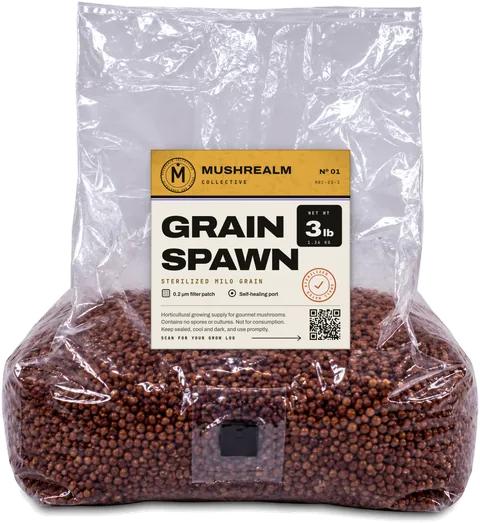
For beginners anywhere, oats or milo are the safe picks, because both resist splitting. If you would rather skip the soaking, simmering and sterilizing, our grain spawn is milo, hydrated and pressure sterilized in a filter patch bag. If you are making your own, our guide to what grain spawn is and how it is made covers the process.
Whatever you choose, a smaller kernel stretches further when you spawn to bulk, because it gives more starting points for the same weight. The spawn to bulk guide covers ratios, and the contamination guide will help if a batch of homemade grain goes sour.
Quick checklist
- Every grain here works. Ease of prep, inoculation points and local price are what separate them.
- Oats and milo are the most forgiving; rye, wheat and brown rice split most easily.
- Millet gives the most inoculation points; popcorn gives the fewest.
- In the US, milo is cheap and everywhere. In the UK, whole oats are.
- Use whole, untreated grain from a single type, and rinse it well.
- Hydration and clean technique matter more than which grain you pick.
Frequently asked questions
Is milo or millet better for grain spawn?
Are rye berries better than oats for mushroom spawn?
Can I use rolled oats or oatmeal for grain spawn?
Can I use bird seed for grain spawn?