The short answer is two to three weeks for most gourmet species at a comfortable room temperature, but the range is wide. A warm pink oyster bag inoculated generously can finish in about a week, while a cool maitake bag can still be working after a month. Below are realistic timelines by species, what speeds a bag up, when to do the break and shake, and how to know it is genuinely finished.
Typical colonization times by species
These figures assume a reasonable amount of liquid inoculant or a grain transfer, one break and shake, and steady temperatures. A large grain-to-grain transfer is often faster.
| Species | Incubation temperature | Typical time to full colonization | Notes |
|---|---|---|---|
| Pearl and blue oyster | 21 to 24°C (70 to 75°F) | 10 to 21 days | Vigorous, dense white growth |
| Pink oyster | 24 to 29°C (75 to 85°F) | 7 to 14 days | Loves warmth; never refrigerate |
| Golden oyster | 24 to 27°C (75 to 80°F) | 10 to 18 days | Likes it slightly warm |
| King oyster | 21 to 24°C (70 to 75°F) | 14 to 24 days | Slower than other oysters |
| Lion's mane | 21 to 24°C (70 to 75°F) | 14 to 28 days | Thin, wispy growth looks sparse |
| Shiitake | 21 to 24°C (70 to 75°F) | 14 to 28 days | Browns in patches as it matures |
| Reishi | 24 to 27°C (75 to 80°F) | 14 to 28 days | Often turns yellowish |
| Maitake | 21 to 24°C (70 to 75°F) | 21 to 35 days | Slowest of the common species |
If your bag falls outside these ranges by a few days, that is normal. If it is weeks behind, work through the causes further down.
How temperature changes colonization time
Temperature is the biggest lever you control.
- Below about 18°C (64°F), most species slow noticeably. A bag that would finish in two weeks can drag on much longer. Cold rooms in winter or late fall are a common reason for slow bags.
- 21 to 24°C (70 to 75°F) is the sweet spot for most gourmet species.
- Above about 27°C (80°F), most species (apart from warm-lovers like pink oyster) start to struggle, while bacteria and green mold speed up. Faster is not better if it invites contamination.
Two practical points:
- The bag runs warmer than the room. Colonizing grain generates its own heat, so the middle of a bag can sit a couple of degrees above the air around it, and more in a tight stack. Leave a little space between bags.
- Steady beats perfect. A constant 21°C (70°F) is better than a room that swings between 18 and 27°C (64 and 80°F). Big swings also cause heavy condensation inside the bag.
A cupboard or shelf away from radiators, heaters and sunny windows is usually enough. Darkness is not essential, but direct sunlight heats the bag and can make oysters pin early. A cheap thermometer next to the bags tells you more than guessing.
The break and shake
The break and shake is the single best way to shorten colonization time.
What it does
Mycelium grows outward from wherever the inoculant landed. Early on, that means a few white islands and a lot of bare grain. Breaking up those islands and shaking the bag scatters colonized kernels throughout, so every one of them becomes a new growth point and the bag closes in from many places at once.
When to do it
Wait until roughly 20 to 30 percent of the grain is covered in healthy, actively spreading white growth. For a fast oyster, that might be five to eight days after inoculation; slower species take longer.
- Too early: there is too little mycelium to spread, and you can set the bag back.
- Too late: past about two-thirds colonized, there is little left to gain, and the bag has to recover for nothing.
How to do it
- Check the bag first. Never shake a bag that shows green, odd colors, wet slimy kernels or a sour smell. Shaking spreads contamination through the whole bag.
- Keep it sealed. Hold the bag closed above the grain without pressing on the filter patch.
- Break up the white patches. Massage the colonized clumps apart through the plastic with your fingers until they are loose kernels.
- Shake and roll. Tumble the bag until colonized and bare grain are evenly mixed.
- Settle it. Lay or stand the bag so the grain sits in an even layer, filter patch uncovered, and return it to incubation.
- Expect a quiet day or two. The bag looks almost bare for 24 to 72 hours, then white growth appears everywhere at once.
One shake is usually enough. Some growers do a second, lighter one if a bag is lagging, but avoid it once the bag is mostly colonized.
How to know it is fully colonized
A bag is done when:
- Every kernel is coated white, with no bare grain visible from any side, including the bottom and the corners. Hold it up to a light to check.
- The grain is knitted into a firm block that holds together when you press it gently.
- It smells fresh and earthy, never sour.
Many growers then give it two to five more days to consolidate. The mycelium thickens through the grain, and well-consolidated spawn recovers faster after it is mixed into bulk substrate.
Do not leave it too long. A bag sitting for weeks after full colonization may start forming mushrooms inside (common with oysters), build up yellow metabolites and lose vigor. Use it within a week or two, or keep it in a fridge at 2 to 4°C (36 to 39°F) for several weeks. Pink oyster is the exception: cold damages its mycelium, so use it promptly instead.
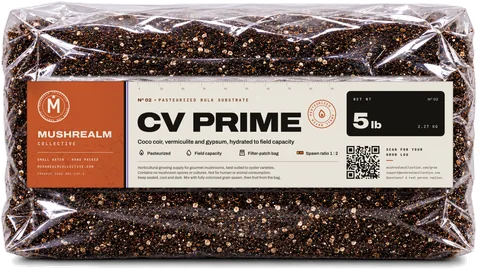
When it is ready, mix it into your bulk substrate. For oysters, CV Prime colonizes quickly at our kit ratio of about 1 : 2 grain to substrate by weight, and the spawn to bulk guide covers mixing.
What slows colonization down
| Cause | Signs | Fix |
|---|---|---|
| Too cold | Slow but clean, healthy-looking growth | Move to 21 to 24°C (70 to 75°F) |
| Too little inoculant | A few small islands, little spread | Inoculate more generously next time; do the break and shake |
| Weak or old inoculant | Very slow start, thin growth | Use fresh, vigorous inoculant |
| Filter patch covered or wet | Stalling, heavy condensation | Keep the filter clear and dry |
| Grain too wet | Pooled water, glossy kernels | Watch for bacteria; drier grain next time |
| Bacteria or mold | Mycelium stops at certain kernels, sour smell or colored patches | See the contamination guide |
| Too hot | Growth slows, metabolites build up | Move somewhere cooler and leave space between bags |
| Species | Everything looks healthy, just slow | Patience; check the table above |
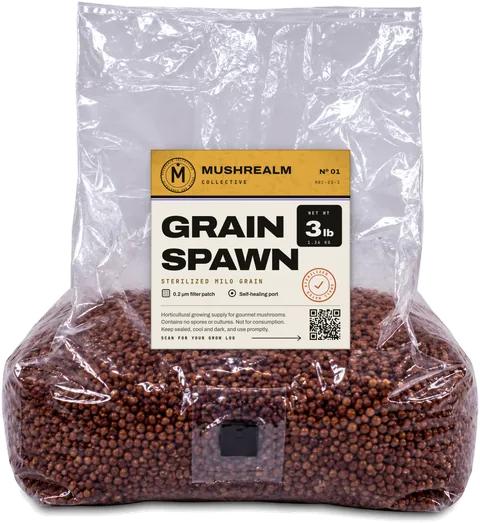
The grain matters a little too. Small kernels give more starting points after the shake, which is one reason our US bench uses milo; our oats vs milo comparison covers the trade-offs.
A typical oyster timeline
For a bag of our grain spawn inoculated with pearl oyster at about 22°C (72°F), you might see roughly this:
- Day 0: inoculate through the self-healing injection port. Our inoculation tutorial covers clean technique.
- Days 2 to 5: first white fuzz around the inoculation points.
- Days 5 to 8: patches spreading; break and shake at 20 to 30 percent.
- Days 8 to 10: a day or two of quiet, then white throughout the bag.
- Days 10 to 16: full colonization.
- Plus 2 to 5 days: consolidation, then spawn to bulk.
The short version
- Most gourmet species colonize grain in 10 to 21 days at 21 to 24°C (70 to 75°F); slower species take three to five weeks.
- Keep temperatures steady, and avoid sustained heat above about 27°C (80°F) for most species.
- Break and shake once, at roughly 20 to 30 percent colonized, and never shake a suspect bag.
- Fully colonized means white on every side and a firm block. Give it a few extra days, then use it within a week or two.
- A slow but clean bag is usually just cold or lightly inoculated.
Frequently asked questions
How long does grain spawn take to colonize?
What temperature should grain spawn be kept at?
When should I break and shake grain spawn?
Can grain spawn sit too long after it is colonized?