Mushroom growing has its own vocabulary, and most guides assume you already speak it. Here are the 50 terms you will meet most often growing gourmet mushrooms such as oysters, from sealed grain bag to last flush.
Common abbreviations at a glance
| Abbreviation | Stands for | Where you will see it |
|---|---|---|
| BE | Biological efficiency | Comparing yields |
| CV | Coir and vermiculite | Bulk substrate recipes |
| CVG | Coir, vermiculite and gypsum | Bulk substrate recipes |
| FAE | Fresh air exchange | Fruiting |
| G2G | Grain-to-grain transfer | Expanding your spawn |
| IPA | Isopropyl alcohol | Clean technique |
| RH | Relative humidity | Fruiting |
| SAB | Still air box | Inoculation and spawn to bulk |
| SGFC | Shotgun fruiting chamber | Fruiting |
A to C
Abort
A pin that stops growing and darkens or dries out while its neighbors carry on. A few are normal. Lots of them usually mean the surface dried out or the temperature swung.
Aerial mycelium
Fluffy white mycelium growing up off the surface, usually when humidity and carbon dioxide are both high. It is harmless and settles with more fresh air.
Biological efficiency (BE)
The standard yield measure: fresh weight of mushrooms divided by dry weight of substrate, times 100. Our biological efficiency guide shows how to work it out.
Break and shake
Massaging a grain bag from the outside once it is roughly 20 to 30% colonized, so pockets of mycelium spread through the rest of the grain. It usually shortens colonization.
Bulk substrate
The larger volume of material mushrooms fruit from, such as coir and vermiculite, straw or sawdust. Colonized grain is mixed into it at spawn to bulk.
Casing layer
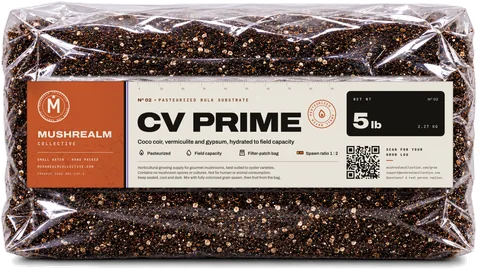
A thin layer of moist, low-nutrient material over a colonized substrate that holds surface moisture and encourages pinning. Standard for button mushrooms, optional for most others. CV Prime also works as a casing layer.
CO2 (carbon dioxide)
The gas mycelium breathes out. High CO2 does no harm during colonization, but during fruiting it causes long stems and tiny caps.
Cobweb mold
A gray, wispy mold that spreads across a surface very quickly. Aerial mycelium is whiter, denser and slower, which is the easiest way to tell them apart.
Coir (coco coir)
Fiber from coconut husks, sold as compressed bricks. It holds a lot of water, stays airy and gives molds little to feed on.
Colonization
Mycelium growing through grain or substrate and binding it together. Fully colonized means white throughout, with no bare grain or loose substrate.
Contamination
Any unwanted organism in your grain or substrate, usually a mold, bacteria or yeast. Our grain spawn contamination guide explains how to recognize the common ones.
CV
Coir and vermiculite, the most popular bulk substrate for home growers. It is low in nutrients, so it is pasteurized rather than sterilized.
CVG
Coir, vermiculite and gypsum (calcium sulfate, a mineral some growers add to substrate and grain recipes). See our CV vs CVG comparison.
F to G
FAE (fresh air exchange)
Replacing the CO2-rich air around a fruiting bag with fresh air, by fanning, opening the container, drilling holes or running a small fan. It is one of the strongest triggers for pinning.
Field capacity
The point where a substrate holds all the water it can without free water collecting. A hard squeeze should give a few drops, not a stream. See field capacity explained.
Filter patch
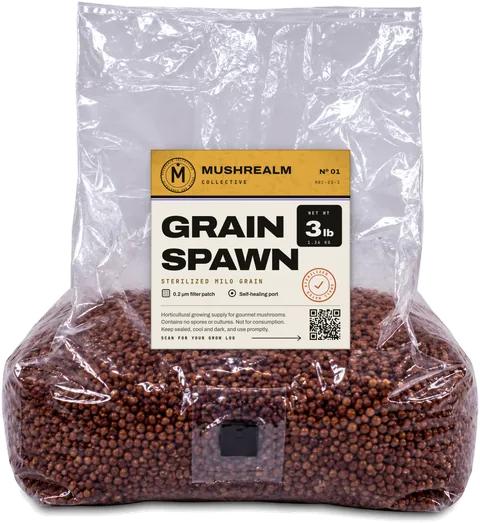
A breathable panel on a grow bag that lets gases pass but blocks dust and contaminants. Our grain bags use a 0.2 micron patch.
Flow hood
A laminar flow hood: a fan pushing air through a HEPA filter to send a steady stream of clean air across your work. The step up from a still air box.
Flush
One wave of mushrooms from the same bag or block. Most bags give two to four, the first usually the largest. Soaking a block in cool water between flushes (dunking) replaces the water each crop takes out.
Fruiting body
The mushroom itself, the part you harvest: the cap, the stem (stipe) and the gills or other structures under the cap.
Fuzzy feet
White fuzz around the base of the stems, a sign of too much CO2. More fresh air usually clears it by the next flush.
Gills
The thin, blade-like ridges under the cap, also called lamellae. On oyster mushrooms they run down onto the stem, which is called decurrent.
Grain spawn
Grain that has been hydrated, sterilized and fully colonized by mycelium, ready to mix into bulk substrate. A sterilized grain bag becomes grain spawn once you inoculate it and it colonizes.
Grain-to-grain transfer (G2G)
Using colonized grain from one bag to inoculate fresh sterile grain. The cheapest way to multiply spawn, if the source bag is completely clean.
H to M
Hyphae
The microscopic threads that make up mycelium (singular: hypha). They grow from their tips and branch into a network.
Incubation
The colonization stage, in darkness or low light at a steady temperature. Around 20 to 24°C (68 to 75°F) suits most oyster species.
Injection port
A self-healing port on a grain bag. A sterile needle passes through it to add a liquid inoculant, and it reseals afterwards, so the grain never meets open air.
Inoculation
Introducing live mycelium of a gourmet species into sterile grain or substrate: for example a colonized grain transfer, a commercial grain spawn of the species, or a liquid inoculant added through the injection port.
Isopropyl alcohol (IPA)
The standard disinfectant for gloves, tools and surfaces, used at 70%. The water helps it kill microbes and slows evaporation, so it outperforms 99%. In the US it is sold as rubbing alcohol, commonly at 70%.
Masters mix
Roughly equal parts hardwood sawdust and soybean hulls, hydrated and sterilized. Popular for heavy oyster yields, and too rich to be merely pasteurized.
Metabolites
Yellow to amber droplets on mycelium, a by-product of growth that often appears under stress from heat or a competing contaminant. Usually harmless, but worth watching.
Mycelium
The living body of a fungus: a network of hyphae growing through its food source. The mushrooms you harvest grow from it.
O to S
Overlay
A dense mat of mycelium on the surface instead of pins, usually from too little fresh air or leaving a bag in colonizing conditions too long. Pins struggle to break through it.
Pasteurization
Heating a substrate to roughly 65 to 80°C (150 to 175°F) for one to two hours. It knocks back competitors but leaves some harmless microbes alive, which suits low-nutrient substrates like CV and straw.
Pinning
The stage when pins first appear. A good pinset usually follows a drop in CO2, a rise in humidity, some light and, for many species, a slightly cooler room.
Pressure cooker
A sealed pot that reaches about 121°C (250°F) at 15 psi, the standard way to sterilize grain at home, since boiling is not enough. Ready-made sterilized grain bags remove the need for one.
Primordia
The earliest form of a mushroom, a tiny knot of hyphae that becomes a pin (singular: primordium). Many growers use "primordia" and "pins" interchangeably.
Relative humidity (RH)
How much moisture the air holds compared with the most it could hold at that temperature. Most gourmet species fruit best at about 85 to 95%.
Rhizomorphic
Mycelium that grows in rope-like strands. Often read as a sign of a vigorous strain, though plenty of good strains grow differently.
Shotgun fruiting chamber (SGFC)
A clear tub drilled with holes about 6 mm (1/4 in) wide every 5 cm (2 in) on all sides, standing on wet perlite. The holes give passive fresh air and the perlite holds humidity.
Spawn ratio
How much spawn you mix with how much bulk substrate, also called the spawn rate. Our kits pair grain and substrate at about 1:2 by weight. More spawn colonizes faster and leaves less room for competitors.
Spawn to bulk
Mixing fully colonized grain spawn into bulk substrate. Our spawn to bulk guide walks through it.
Sterilization
Killing every living organism in a material, usually with steam at 121°C (250°F) for 90 minutes or more depending on the load. Grain and supplemented sawdust need it.
Still air box (SAB)
A clear plastic tote with two arm holes. With no drafts inside, airborne particles settle instead of drifting into open bags. Our clean technique guide shows how to build one.
Supplementation
Adding nitrogen-rich ingredients such as wheat bran or soybean hulls to sawdust to raise yields. Supplemented substrates must be sterilized, because the extra nutrients feed molds too.
T to W
Tomentose
Fluffy, cotton-like mycelium growth, the opposite of rhizomorphic. A normal pattern for many strains, not a fault.
Trichoderma
A genus of fast-growing mold and one of the most common competitors in grain and substrate. It starts as white patches that look like mycelium, then turns bright green. Keep the bag sealed and get it out of the house.
Veil
A thin tissue protecting the young gills of some species. A partial veil joins the cap edge to the stem and often leaves a ring on the stem when it tears.
Vermiculite
A mineral expanded by heat into light, absorbent granules. It holds water and air in a substrate and does not break down.
Wet spot
Bacterial contamination in grain: kernels that look wet, slimy or dull and smell sour, usually linked to grain that was too wet or not fully sterilized.
Wood lover
Shorthand for species that fruit best on hardwood, such as shiitake, lion's mane, maitake and reishi. They want supplemented hardwood sawdust or logs rather than CV, though grain spawn can still be used to spawn them.
The short version
- Five terms cover a whole grow: colonization, spawn to bulk, field capacity, FAE and flush.
- Green patches usually mean Trichoderma, sour and slimy means bacteria, and yellow droplets are usually just metabolites.
- Pasteurize low-nutrient substrates like CV. Sterilize grain and anything supplemented.
- Long stems and fuzzy feet call for more fresh air. Dry, dark pins call for more humidity.
- Our grain spawn arrives sterilized with a filter patch and injection port, so your first step is inoculation.
Frequently asked questions
What does FAE mean in mushroom growing?
What is the difference between rhizomorphic and tomentose mycelium?
What is the difference between pasteurization and sterilization?
What is a flush in mushroom growing?