"How much will I get?" is the first question most growers ask, and the honest answer is that it depends on the species, the substrate and how the grow goes. Biological efficiency is how growers put a number on it, so you can compare one bag with the next, test a change and see whether it actually helped. Here is how it works, what is typical, and what to expect from a bag of CV Prime.
What biological efficiency means
Biological efficiency (BE) compares the mushrooms you harvest with the food you gave them:
BE (%) = fresh weight of mushrooms ÷ dry weight of substrate × 100
So 800 g of fresh mushrooms from 1 kg of dry substrate is 80% BE.
Dry weight is used because water content varies wildly from one substrate to another, while the dry matter is the actual food. Fresh mushrooms, on the other hand, are around 90% water. That mismatch is why BE can go over 100%: a very productive grow can harvest more fresh weight than the substrate weighed dry.
One choice to make: some growers count only the bulk substrate, others add the dry weight of the grain spawn too. Including the grain gives a lower, more honest figure, especially on coir and vermiculite, where much of the food comes from the grain. Either way works as long as you stay consistent.
How to calculate BE, step by step
- Find the dry weight of your substrate. If you mix your own, weigh the dry ingredients before adding water. For pre-hydrated substrate, use the oven test below.
- Weigh every harvest fresh, on the day you pick it. Trim or do not trim the stems, but do it the same way every time.
- Add up all the flushes from that bag.
- Divide the total fresh weight by the dry weight and multiply by 100.
Worked example: 1.2 kg (2.6 lb) of fresh oysters from 1.5 kg (3.3 lb) of dry straw is 1.2 ÷ 1.5 × 100 = 80% BE.
The oven test for dry weight
- Weigh out 200 g (7 oz) of substrate onto a baking tray.
- Dry it in a low oven, around 100°C (212°F), for a few hours, until two weighings an hour apart match.
- Divide the dry weight by 200 g. If 40 g is left, the substrate is 20% dry matter.
- Multiply the weight of the whole bag by that figure to get its dry weight.
Throw the dried sample away afterwards rather than returning it to the bag.
Typical BE by species and substrate
These are typical ranges, not guarantees. Strain, spawn rate, conditions and the grower all move the number.
| Species | Substrate | Typical BE | Notes |
|---|---|---|---|
| Oyster (blue, gray, white) | Pasteurized straw | 50 to 100% | The classic benchmark |
| Oyster | Supplemented hardwood sawdust, such as masters mix | 75 to 100%, sometimes more | Richer food; must be sterilized |
| Oyster | Coir and vermiculite plus grain spawn | 40 to 80% is a fair home target | Much of the food comes from the grain |
| Shiitake | Supplemented hardwood sawdust | 50 to 100% | Long incubation before fruiting |
| Shiitake | Hardwood logs | Rarely measured as BE | Fruits over several years |
Wood lovers such as shiitake and lion's mane belong on supplemented hardwood sawdust or logs, not coir and vermiculite. We do not sell sawdust, but our grain spawn can be used to spawn either. For oysters, CV is the easy, low-risk choice. See mushroom substrate types for how the options compare.
How much will one bag of CV Prime produce?
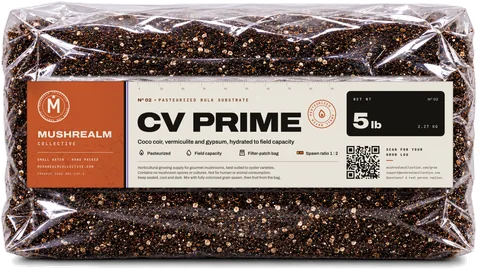
Here is the method applied to one 5 lb bag of CV Prime with its matching 3 lb milo grain bag, the pairing in our grow kit. The dry matter figures are example assumptions, not measured product specs: hydrated coir and vermiculite is mostly water, and hydrated grain is roughly half water. Run the oven test on your own bags if you want exact numbers.
| Component | Wet weight | Assumed dry matter | Dry weight |
|---|---|---|---|
| CV Prime | 2.3 kg (5 lb) | 15% | 0.34 kg (0.75 lb) |
| Milo grain spawn | 1.4 kg (3 lb) | 50% | 0.68 kg (1.5 lb) |
| Total | 3.6 kg (8 lb) | about 1 kg (2.2 lb) |
At 40% BE that is about 400 g (0.9 lb) of fresh oysters across all flushes. At 60%, about 600 g (1.3 lb). At 80%, about 800 g (1.8 lb).
Treat that as a planning range, not a promise. Species, strain, how fully the bag colonized and your fruiting conditions all shift the result. To plan several grows at once, the grain and substrate planner works out how much grain and CV Prime you need.
Why BE is not the whole story
- Water weight. Mushrooms weighed straight after heavy misting weigh more. Weigh them the same way every time.
- Quality. Long-stemmed oysters grown with poor fresh air can still weigh a lot, but they eat badly. Weight is not flavor.
- Time. A bag that reaches 60% in five weeks may be better value than one that reaches 90% in three months, especially if space is limited.
- What you count. Including or leaving out the grain spawn changes the figure a lot, so only compare numbers worked out the same way.
What increases yield
- Use enough spawn. More grain means more food and faster colonization. Most home growers use between 1:1 and 1:4 grain to substrate, and our kits sit at about 1:2 by weight. Our spawn to bulk guide covers ratios.
- Colonize fully before fruiting. Uncolonized pockets do not produce mushrooms and invite mold.
- Keep moisture right. Start at field capacity and rehydrate between flushes, because every mushroom carries water out of the substrate. See field capacity explained.
- Get fruiting conditions right. Plenty of fresh air, 85 to 95% humidity and indirect light give thick, heavy caps instead of thin stems. Our guide to mushroom fruiting conditions has the numbers.
- Harvest at the right moment. Pick oysters as the cap edges begin to flatten. You get most of the weight while keeping a good texture.
- Take every flush. The first flush is usually the biggest, but the second and third add up. Follow our guide on how to get a second flush.
- Match the species to the substrate. Oysters on CV Prime, wood lovers on supplemented hardwood sawdust or logs.
- Do not supplement a pasteurized substrate. Adding bran or other nutrients to CV invites mold, because pasteurization leaves some microbes alive. Rich supplements belong in sterilized substrates. On CV, extra grain spawn is the safe way to add food.
Keep a yield log
A notebook or spreadsheet with one line per harvest is enough. Record the bag, species, date of spawn to bulk, dry weight of substrate (and grain, if you count it), the date and fresh weight of each flush, and a note on conditions. After a few bags you will see which changes actually moved your numbers.
The short version
- BE = fresh mushroom weight ÷ dry substrate weight × 100.
- Oysters on straw typically reach 50 to 100%. On CV with grain spawn, 40 to 80% is a fair home target. None of these figures are guaranteed.
- Find dry weight by weighing ingredients before hydrating, or with the oven test.
- From one 5 lb bag of CV Prime plus 3 lb of grain, a realistic planning range is roughly 400 to 800 g (0.9 to 1.8 lb) of fresh oysters across all flushes, using the assumptions above.
- Yield goes up with enough spawn, full colonization, good moisture, fresh air, timely harvests and more flushes.
Frequently asked questions
What is a good biological efficiency for oyster mushrooms?
How much do oyster mushrooms yield per kg of substrate?
Can biological efficiency be over 100%?
How many flushes do mushrooms produce?