Get moisture right and almost everything else about a grow gets easier. Get it wrong and no amount of humidity or fresh air will save it, because water is very hard to adjust once a substrate is spawned. Field capacity is the target, and the squeeze test is how you hit it. Here is what both mean, how to fix a batch that is off, and why it matters so much for pinning and contamination.
What field capacity means
The term comes from soil science. Field capacity is the amount of water soil holds after it has been soaked and the excess has drained away under gravity.
For mushroom substrate it means the same thing: the material holds as much water as its fibers and pores can grip, with no free water pooling or dripping out. The larger gaps between particles still hold air.
That balance is the whole point. Mycelium needs water to grow and to build mushrooms, and it needs oxygen to breathe. A substrate at field capacity offers the most water you can give it without filling those air spaces.
Field capacity is not one fixed moisture percentage. Each material holds a different amount: supplemented sawdust is commonly prepared at around 60 percent moisture by weight, while coir and straw sit at their own levels. That is why growers rely on a hands-on test rather than a single number.
How to do the squeeze test
- Wash your hands well or put on clean gloves. Pasteurized substrate is clean; keep it that way.
- Take a handful from the middle of the batch. The surface dries first and the bottom collects water, so neither tells the truth.
- Squeeze hard, as if you were wringing out a sponge.
- Watch your knuckles and the gaps between your fingers.
- Open your hand and look at the lump.
Here is how to read the result:
| What you see | What it means | What to do |
|---|---|---|
| A stream, or drops running down your wrist | Too wet | Drain it or add dry material |
| A few drops between your fingers | Field capacity | Use it |
| No drops, but the lump holds its shape | Slightly dry, which is safer than slightly wet | Usable, or add a splash of water and retest |
| No drops, and it crumbles apart | Too dry | Add water in stages |
A useful habit: test two or three handfuls from different spots. If they disagree, the batch isn't mixed evenly yet.
Fixing substrate that's too wet or too dry
Too wet
Too wet is the more dangerous mistake. Luckily it is easy to fix before spawning:
- Drain it. Tip it into a clean colander or mesh bag and let gravity work for 30 minutes or so. Straw can hang in its mesh bag until it stops dripping.
- Wring it. For CV, pack some into a clean pillowcase and twist, then retest after each squeeze so you don't overshoot.
- Add dry vermiculite. Mix it in a little at a time; it soaks up water quickly. Vermiculite is inert and gives molds nothing to eat, so a small dry top-up carries little risk.
Spreading wet substrate out in the open to evaporate does work, but slowly, and it gives airborne contaminants hours to land. Keep it as a last resort.
Prevention is easier than cure: add water in stages and test before you pour in the last of it.
Too dry
- Add water a little at a time. Use boiled and cooled water, about a cupful at a time for a bucket of CV. Mix thoroughly, wait 10 minutes for it to soak in, then test again.
- Use a spray bottle for small amounts, such as a single bag's worth.
- Break up lumps. Dry pockets inside clumps of coir can make a batch seem wetter on the outside than it really is.
Once a substrate is spawned and colonizing, leave it alone. Rehydrating comes later, between flushes, when you soak a fruited block or bag to replace the water the mushrooms used. Our guide on how to get a second flush covers it.
Why field capacity matters
For colonization and pinning
Mushrooms are around 90 percent water, and nearly all of it comes from the substrate. Humidity in your fruiting space mainly slows evaporation from the surface; it supplies very little water to the mushrooms themselves. That makes substrate moisture the water supply for the whole harvest.
- Too dry: colonization slows, the mycelium looks thin, and pins form late, in small numbers, or stall and dry out. Later flushes shrink fast because the reserve runs out.
- Too wet: water fills the air spaces and the mycelium runs short of oxygen. Growth stalls, often at the bottom of the bag where water collects.
- At field capacity: fast, even colonization, plenty of pins, and enough water held back for more than one flush.
For contamination
Bacteria thrive in free water. Pooled liquid and soggy pockets are where bacterial contamination usually starts, and you will know it by the smell: sour, sweet-rotten or like vinegar, often with slimy, discolored patches.
Molds take advantage in a different way. When soggy conditions stall the mycelium, uncolonized substrate sits exposed for longer, giving molds such as green Trichoderma time to get a foothold.
Dry substrate is less of a magnet for bacteria, but it shares the same weakness: slow colonization leaves the door open for longer. For more on spotting and preventing problems, see common mushroom growing mistakes and clean technique for mushroom growing.
Field capacity on different substrates
| Substrate | What right looks like | Watch out for |
|---|---|---|
| CV | A few drops on a hard squeeze; holds its shape and crumbles when poked | Easiest to judge; water pooling in the bag bottom means too wet |
| Straw | Drained until it stops dripping; a few drops when squeezed | A hot water bath leaves it soaked, so drain fully before spawning |
| Supplemented sawdust or masters mix | Forms a ball, a drop or two at most | Often prepared around 60 percent moisture; excess water settles at the bottom of bags |
| Coffee grounds | Damp, not dripping | Fresh grounds are often too wet, so drain them first |
| Grain spawn | Kernels plump and soft through, no free water in the bag | Not squeeze tested; see grain spawn bags explained |
Measuring moisture by weight
For repeatable batches, you can measure the actual moisture content with a kitchen scale and an oven:
- Weigh a sample of substrate, say 100 g (3.5 oz).
- Spread it on a tray and dry it in the oven at about 100 to 105°C (212 to 221°F) until the weight stops dropping, usually a few hours.
- Weigh it again.
- Moisture content = (wet weight minus dry weight) divided by wet weight, times 100.
For example, 100 g of substrate that weighs 35 g after drying was 65 percent water. Once you know the number for a batch that passed the squeeze test, you can hit it again every time. Throw the dried sample away afterwards.
Keeping moisture right through the grow
- Keep grow bags sealed during colonization. The filter patch lets air exchange without letting the substrate dry out.
- When fruiting oysters, aim for around 85 to 95 percent humidity with steady fresh air. Our guide to mushroom fruiting conditions has the details.
- If you use CV as a casing layer, mist it lightly to keep it at field capacity. A dried-out casing stops pinning.
- Weigh a bag or block before it fruits. After a flush, rehydrating it back close to that starting weight is a simple, reliable target.
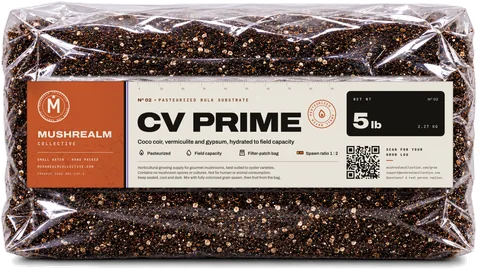
If you would rather skip the testing, CV Prime arrives already hydrated to field capacity, so you can mix in grain straight away. If you like to check anyway, the squeeze test takes ten seconds.
Quick checklist
- Field capacity means holding all the water it can, with nothing pooling.
- Squeeze hard: a few drops is right, a stream is too wet, nothing and crumbling is too dry.
- Test from the middle, in two or three spots.
- Too wet: drain, wring or add dry vermiculite. Too dry: add boiled and cooled water in stages.
- Slightly dry is safer than slightly wet.
- Fix moisture before spawning; rehydrate only between flushes.
Frequently asked questions
What is field capacity in mushroom growing?
How many drops should come out in a squeeze test?
What happens if mushroom substrate is too wet?
Can you fix substrate moisture after spawning?