Shiitake (Lentinula edodes) is one of the most satisfying mushrooms to grow, and one of the most misunderstood. It is not difficult, but it is slow, and it needs wood. You have two routes: hardwood logs, which take patience and very little else, or supplemented sawdust blocks, which are faster but need sterilizing and a bit of technique. This guide covers both, honestly.
Logs or blocks?
| Hardwood logs | Supplemented sawdust blocks | |
|---|---|---|
| Substrate | Freshly cut oak or other dense hardwood | Hardwood sawdust plus bran, sterilized |
| Spawn | Plug (dowel) spawn or sawdust spawn | Grain spawn or sawdust spawn |
| Equipment | Drill, hammer or inoculation tool, wax | Pressure cooker or steam sterilizer, filter patch bags |
| Time to first harvest | 6 to 18 months | About 2 to 4 months |
| Productive life | Several years, often 3 to 5 | 2 to 4 flushes over a few months |
| Where | Shady outdoor spot | Indoors, year-round |
| Effort | One busy afternoon, then waiting | More hands-on throughout |
If you have a garden and patience, logs are the easiest shiitake you will ever grow. If you want mushrooms this season and indoors, choose blocks.
Why not coir, and where grain spawn fits
Shiitake is a wood-decay fungus. It fruits poorly, if at all, on coir and vermiculite, so CV Prime is not the right bulk for it. CV Prime is made for oysters. Our guide to mushroom substrate types explains which species suit which material.
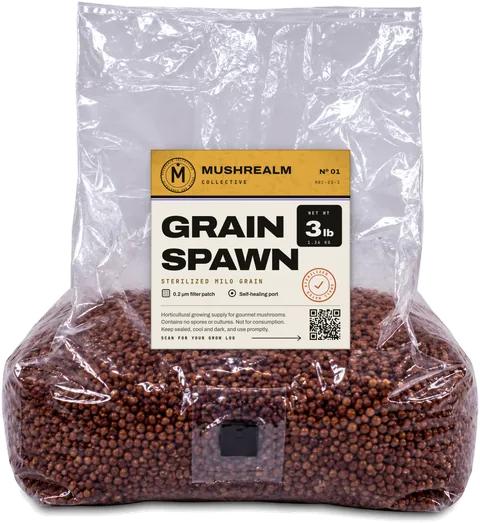
We do not sell sawdust or logs, but grain spawn is still the usual starting point:
- For blocks: colonize a sterilized grain bag with live shiitake mycelium, such as a commercial grain spawn of the species or a liquid inoculant added through the self-healing injection port, then mix it into sterilized supplemented sawdust. See how to inoculate grain spawn bags.
- For logs: grain is not a good choice straight into log holes, because exposed grain attracts insects, birds and rodents and dries out. Instead, use colonized grain to spawn a batch of sterilized hardwood sawdust. Once fully colonized, that is sawdust spawn, ready for an inoculation tool.
Growing shiitake on logs
Choose and cut the logs
- Wood: oak is best (white or red oak). Sugar maple, sweetgum, hornbeam and beech also work. Avoid conifers.
- Size: 7.5 to 15 cm (3 to 6 in) across and about 1 m (3 to 4 ft) long. Bigger logs last longer but take longer to colonize and are heavy to move.
- Timing: cut from healthy living trees while they are dormant, in late winter before the buds break, so the bark is tight.
- Handle with care: bark damage lets competing fungi in. Keep logs off the ground and out of sun, and inoculate within about six weeks of cutting, before the wood dries.
Inoculate
- Drill the holes about 2.5 to 3 cm (1 to 1 1/4 in) deep, using the bit size your spawn supplier specifies. That is commonly about 8 mm (5/16 in) for plugs and 12 mm (7/16 in) for sawdust spawn.
- Space them in a diamond pattern: holes 10 to 15 cm (4 to 6 in) apart along each row, rows 5 to 7.5 cm (2 to 3 in) apart, each row offset from the last. A 1 m log about 10 cm (4 in) thick takes roughly 30 to 50 holes.
- Fill each hole straight away. Tap plugs in flush with a hammer, or pack sawdust spawn in with an inoculation tool.
- Seal with wax. Dab melted food-grade wax (cheese wax, beeswax or paraffin wax) over every hole, plus any bark damage.
- Label the log with strain and date.
The spawn run: 6 to 18 months
Stack the logs in full shade, off the ground on pallets or bricks, and sheltered from drying wind. The one job is to keep them from drying out: if there has been no rain for a couple of weeks, give them a long soak with a hose or sprinkler.
How long it takes depends on log diameter, wood density, strain and climate. Thin logs in a warm climate can be ready within six months; thick oak in a cool climate may take well over a year. The sign to look for is white, mottled mycelium showing on the cut ends.
Fruit the logs
Logs fruit on their own after heavy rain and temperature swings in spring and fall. To force a flush:
- Soak the log in cold water for 12 to 24 hours, weighted down so it stays submerged.
- Stand it upright or lean it against a support in shade.
- Pins usually appear within about a week. Harvest a few days later.
- Rest the log for 6 to 8 weeks before forcing it again.
Strains are sold as cold-weather, warm-weather or wide-range. Choose one that suits your climate, as it decides when your logs will fruit.
Growing shiitake on supplemented sawdust blocks
Make and spawn the blocks
- Mix hardwood sawdust (oak if you can get it) with 10 to 20% wheat bran by dry weight, and hydrate to about 60% moisture: a squeezed handful should release only a few drops.
- Bag and sterilize. Fill filter patch grow bags with about 2 to 2.5 kg (4.4 to 5.5 lb) each and sterilize, typically around 2.5 hours at 15 psi (about 1 bar) in a pressure cooker. Supplemented sawdust must be sterilized, not pasteurized.
- Spawn once fully cool, in a clean space: add colonized grain at about 10 to 20% of the block's wet weight, mix it through and seal the bag. Our spawn to bulk guide explains spawn rates.
Incubate: colonize, popcorn, brown
This is the stage that tests patience, and the one most beginners cut short.
- Colonization. At 21 to 24°C (70 to 75°F), the block turns white in about 3 to 6 weeks.
- Popcorning. The surface forms bumpy white blisters. This is normal.
- Browning. Over the next several weeks, the surface turns brown and bark-like and may weep amber liquid. A few hours of indirect light each day helps. Total incubation is usually 8 to 12 weeks, longer for some strains.
Wait until most of the surface is brown before fruiting. An under-browned block tends to give a weak flush.
Shock and fruit
- Cut away the bag.
- Cold soak the block in cold water for 12 to 24 hours, weighted down.
- Fruit at 13 to 21°C (55 to 70°F), depending on strain, with 80 to 90% humidity, fresh air and indirect light. Pins usually appear within about a week. Our guide to mushroom fruiting conditions covers simple setups.
- Harvest when the caps are mostly open but the edges still curl under. Twist off or cut at the base.
- Rest the block for 1 to 2 weeks, then soak again for the next flush. Expect 2 to 4 flushes.
Troubleshooting shiitake
| Problem | Likely cause | Fix |
|---|---|---|
| Green mold on a block | Incomplete sterilizing or a handling slip | Seal it in a bag and throw it away outside |
| Block stays white, will not brown | Too young, or kept in total darkness | Give it more time and some indirect light |
| No pins after soaking | Not mature enough, or too warm | Wait for more browning; fruit cooler |
| Logs not fruiting after 18 months | Logs dried out, strain does not suit the climate | Soak to force a flush; check the ends for mycelium |
| Cracked, crazed caps | Low humidity | Raise humidity, or enjoy them: cracked "flower" shiitake is prized |
| Long stems, small caps | Too little fresh air or light | Increase air exchange and indirect light |
Harvesting, cooking and storing
Shiitake keeps well, about 7 to 10 days in a paper bag in the fridge, and it is one of the best mushrooms for drying. The stems are tough, so trim them and save them for stock. Always cook shiitake thoroughly: a small number of people get an itchy rash after eating it raw or undercooked. Our guide on how to store fresh mushrooms covers drying and freezing.
The short version
- Shiitake needs hardwood. Coir and vermiculite is not the right bulk.
- Logs: oak, cut in late winter, plug or sawdust spawn, 6 to 18 months to the first flush, then years of crops.
- Blocks: sterilized supplemented sawdust, spawned with colonized grain, 8 to 12 weeks of incubation including browning.
- Wait for the block to brown, then cold soak 12 to 24 hours to trigger fruiting.
- Rest between flushes: 1 to 2 weeks for blocks, 6 to 8 weeks for logs.
- Use grain spawn for blocks, or to make sawdust spawn for logs. Do not put grain straight into log holes.
Frequently asked questions
How long does it take to grow shiitake on logs?
What wood is best for shiitake logs?
Can you grow shiitake on coco coir?
Why is my shiitake block turning brown?
Do shiitake logs need to be soaked?