If you have read more than one home growing guide, you have seen "CV" in the ingredients list. It stands for coco coir and vermiculite, and it is the most common bulk substrate for growing oyster mushrooms at home. Here is what it is, why those two ingredients, which gourmet species do well on it (and which don't), and when it makes sense to mix your own.
What CV substrate is
CV substrate is a mix of coco coir and vermiculite, usually in roughly equal parts by volume, hydrated with hot water to field capacity and pasteurised. It is a bulk substrate: the material you mix colonised grain spawn into so the mycelium has water, air and room to produce mushrooms.
It helps to think of a grow in two stages:
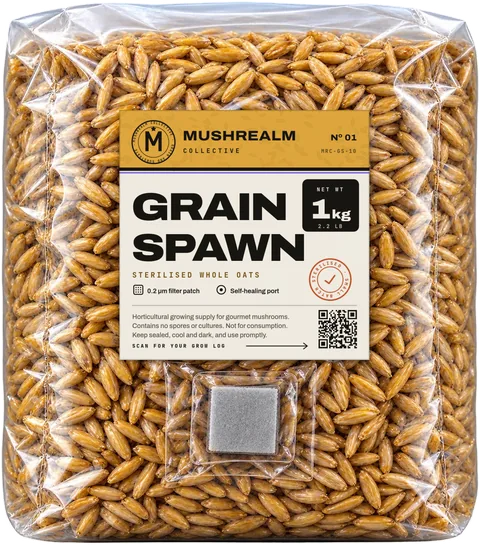
- Grain spawn carries the mycelium and most of the food. It is the engine. If you are new to it, start with what grain spawn is.
- Bulk substrate such as CV supplies water, structure and surface area. It is where the mushrooms actually form.
You will also see CVG, which is CV with gypsum added. We cover that difference in CV vs CVG substrate.
Why coco coir
Coco coir is the fibre from coconut husks, a by-product of coconut processing. It is sold dry and compressed into bricks. A common 650 g (1.4 lb) brick expands to around 7.5 L of fluffy, damp fibre once hydrated.
It earns its place for four reasons:
- It holds a lot of water while staying open and springy, so air still reaches the mycelium.
- It is low in easy food. Coir is mostly tough fibre with very little sugar or starch. Moulds and bacteria have little to live on, which is why CV only needs pasteurising, not sterilising.
- It is consistent. One brick behaves much like the next, unlike straw, which varies from bale to bale.
- It stores well. Dry bricks keep for a long time and take up little space.
Why vermiculite
Vermiculite is a natural mineral that is heated until it puffs up into light, accordion-like flakes. Those flakes soak up water, release it slowly and keep the mix from packing down.
In CV it does three jobs:
- Water reserve. It holds moisture deep in the mix, which helps the substrate last through more than one flush.
- Structure. It stops the coir from compacting, so the mix stays airy.
- Inert filler. It adds no nutrients, so contaminants get nothing from it.
Use coarse or medium grade from a garden centre; fine grade packs down. Pour it outdoors or wear a dust mask, because the dry flakes are dusty.
Which gourmet mushrooms grow well on CV
CV suits species that are happy on low-nutrient material and take most of their food from the grain. That means oysters, above all. Here is our honest read from the bench:
| Species | On CV | Better home |
|---|---|---|
| Pearl and blue oyster | Excellent, our top pick | CV, straw or sawdust all work |
| Golden oyster | Very good | CV or straw |
| Pink oyster | Very good, likes it warm | CV or straw |
| Phoenix (Italian) oyster | Very good | CV or straw |
| King oyster | Possible, less reliable | Supplemented hardwood sawdust |
| Lion's mane | Weak | Supplemented hardwood sawdust |
| Shiitake | Poor | Hardwood sawdust blocks or logs |
| Maitake and reishi | Poor | Hardwood sawdust blocks or logs |
| White button, chestnut (brown cap), portobello | Not suitable as bulk | Manure-based compost |
The wood lovers (shiitake, lion's mane, maitake and reishi) fruit best on supplemented hardwood sawdust, which we don't sell. If those are your target, our grain spawn still works for them: use it to spawn sawdust blocks or logs. Our guide to mushroom substrate types covers those options in detail.
Using CV as a bulk substrate
This is how most people use it. The basic steps:
- Start with fully colonised grain spawn: white all the way through, with no off colours or sour smell.
- Break the grain up inside its bag so the kernels separate.
- Mix it evenly into the CV, typically 1 part grain to 2 to 4 parts CV. Our kits pair about 1:2 grain to CV by weight.
- Pack it loosely into a grow bag or fruiting container and level the surface.
- Let it colonise at around 21 to 24°C (70 to 75°F), out of direct light. Oysters usually take one to three weeks.
- Once it is fully white, switch to fruiting conditions: fresh air, indirect light and high humidity.
The full walkthrough is in how to grow oyster mushrooms on CV substrate, and the spawn to bulk guide explains ratios in depth.
One thing specific to CV: because coir carries so little food, spawn rate matters more than on richer substrates. More grain means faster colonisation, less time for competitors to get a foothold and usually heavier flushes. If a CV grow underwhelms, a higher spawn rate is the first thing we would change.
Using CV as a casing layer
A casing is a thin layer of moist, low-nutrient material spread over substrate that is already fully colonised. It does not feed the mushrooms. Its job is to hold water at the surface, where pins form, and to stop that surface drying out under fresh air.
CV makes a good casing for the same reasons it makes a good bulk: it holds water, stays airy and gives moulds little to eat. To use it:
- Wait until the bulk below is fully colonised.
- Spread an even layer about 1 cm (just under half an inch) deep. Don't press it down.
- Mist lightly so the casing stays at field capacity, and keep fresh air and humidity steady.
- Mycelium grows up into the casing, and pins form at or just under the surface.
Casing is standard practice for button mushrooms, where peat with lime is the traditional mix. Most oyster growers skip it, since oysters fruit happily from cuts or the open top of a bag without one.
Ready-made vs DIY CV
Making CV is not hard, but it takes a bucket, a kettle, an overnight wait and some judgment on moisture. Our coco coir vermiculite ratio guide has the full recipe. Here is how the two routes compare:
| DIY CV | Ready-made CV | |
|---|---|---|
| What you buy | Coir brick, vermiculite | One bag |
| Equipment | Lidded bucket, kettle, gloves | None |
| Time | About 30 minutes of work, then 6 to 8 hours cooling | Open the bag |
| Moisture | You adjust it with a squeeze test | Already at field capacity |
| Batch size | One brick makes roughly 5 to 6 kg (11 to 13 lb) | Sized to your grow |
| Best for | Several grows at once, people who enjoy the process | First grows, small batches, consistency |
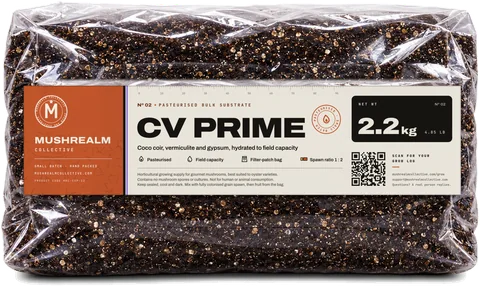
CV Prime is our ready-made option. It is coir and vermiculite, the original MushRealm ACS recipe: the exact blend ACS, our grower, runs in every grow. It arrives pasteurised and hydrated to field capacity, so you mix colonised grain straight into the bag and fruit from it. It comes in 2.2 kg bags (£19.99).
If you are looking for CV substrate in the UK, our UK bench ships CV Prime from within the UK by Royal Mail tracked (1 to 2 working days). If a bag arrives contaminated or damaged, send us a photo within 7 days and we will replace or refund it. Details are on our shipping page.
The short version
- CV is coco coir plus vermiculite, roughly equal parts by volume, hydrated to field capacity and pasteurised.
- Coir holds water and offers moulds little food; vermiculite holds extra water and keeps the mix airy.
- Oysters are the best match. Shiitake, lion's mane, maitake and reishi prefer supplemented hardwood.
- Use it as a bulk substrate mixed with grain, or as a thin casing over colonised bulk.
- Because CV is low in nutrients, a generous spawn rate pays off.
- Make it yourself for big batches, or buy it ready-made to skip the bucket and the guesswork.
Frequently asked questions
What does CV stand for in mushroom growing?
Can you grow mushrooms in just coco coir?
Does CV substrate need to be sterilised?
Is CV substrate good for lion's mane or shiitake?
How much CV substrate do I need?