CV and CVG differ by a single ingredient, usually about a cup of it per batch. Ask ten growers whether that cup of gypsum matters and you will hear ten answers. Here is what gypsum actually is, what it adds to a coco coir and vermiculite mix, when it is worth using, and when you can safely leave it out.
CV vs CVG at a glance
| CV | CVG | |
|---|---|---|
| Ingredients | Coco coir, vermiculite | Coco coir, vermiculite, gypsum |
| Typical gypsum | None | About 1 US cup (240 mL) per 650 g (1.4 lb) coir brick |
| Extra calcium and sulphur | No | Yes |
| Effect on pH | None | Very little |
| Preparation | Bucket pasteurisation | The same, with slightly more water |
| Best for | Oyster varieties | Oyster varieties |
| Effort and cost | Lowest | One more ingredient to buy and measure |
The last few rows are the honest summary: both are low-nutrient bulk substrates aimed at the same mushrooms. If CV itself is new to you, start with what CV substrate is.
What gypsum is
Gypsum is calcium sulphate dihydrate, a soft, white, naturally occurring mineral. Growers buy it as garden gypsum, sold as a soil conditioner, or as gypsum packed for mushroom growing. Either works as long as it is plain gypsum with no added fertiliser.
Two things it often gets confused with:
- Lime. Garden lime (ground limestone) and hydrated lime both raise pH. Gypsum supplies calcium without that pH jump, so the two are not interchangeable.
- Plaster of Paris. This is gypsum that has been heated so it sets hard when wet. Keep it out of your substrate.
What gypsum adds
Calcium and sulphur
Both are minerals that fungi need in small amounts, and gypsum is a convenient source of both. How much difference the extra makes in a CV grow is less clear. Coir carries minerals of its own, and some coir sold for plant growing is "buffered", meaning it has been treated with a calcium solution before sale. More to the point, in a CV grow most of the food comes from the grain spawn, not the bulk.
Texture
Gypsum's clearest role in mushroom growing is physical. In grain spawn it coats the kernels and helps stop them sticking together, and it is a standard ingredient in the compost used for button mushrooms, where it helps the compost's structure. In CV, some growers find it gives a looser, crumblier mix; others notice no difference at all.
pH
You will read that gypsum "buffers" a substrate. It is close to neutral and does not push pH up the way lime does, so it is not a meaningful pH tool. If you actually want to change pH, gypsum is the wrong ingredient.
The debate: does gypsum help on CV?
We are not aware of solid controlled trials comparing coir-based substrates with and without gypsum for gourmet species. What exists is grower experience, and it points both ways. Plenty of experienced growers run plain CV for years without problems; others won't make a batch without gypsum.
Our read from the bench: gypsum is a mineral supplement, not food. On CV, yields are driven mainly by:
- Spawn rate, because the grain carries most of the nutrition.
- Moisture, meaning the substrate sits at field capacity.
- Fruiting conditions, especially fresh air and humidity.
- The strain you are growing.
If one of those is off, gypsum won't rescue the grow. If all of them are right, any effect gypsum has is likely to be small. That's why we would fix spawn rate and moisture long before reaching for the gypsum bag.
When growers add gypsum
Gypsum earns its keep in a few places:
- Grain spawn. A small amount in grain prep helps keep kernels separate. That is a grain question rather than a CV one; see best grains for mushroom spawn.
- Supplemented sawdust and masters mix. Recipes for these richer substrates often include a little gypsum alongside the bran or soy hulls.
- Button mushroom compost, where it is a standard part of the process.
- Following a recipe, or habit. Many popular CV recipes list it, so many growers include it by default.
- Clumpy mixes. Some growers add it when their coir tends to form wet lumps.
When it doesn't matter
- Oysters on CV with a healthy spawn rate. This is the most common home grow, and plain CV handles it well.
- Small hobby grows, where any difference would be hard to notice.
- When moisture is wrong. Too wet or too dry will swamp any gypsum effect, so fix that first.
- When you use ready-made substrate. The recipe is already set; your job is spawning and fruiting.
How to make CVG if you want to try it
Use the standard recipe from our coco coir vermiculite ratio guide and add gypsum with the dry ingredients:
- Put a 650 g (1.4 lb) coir brick and about 7.5 to 8.5 L of vermiculite in a clean, lidded bucket.
- Sprinkle in about 1 US cup (240 mL) of gypsum. Some recipes use up to 2 cups; more is not better.
- Pour in boiling water as usual, holding a little back. Gypsum takes up a small amount of water, so you may need slightly more than for plain CV.
- Lid on, insulate, stir once the brick softens, then leave it 6 to 8 hours to cool.
- Finish with the squeeze test: a few drops, no stream.
Run your own test
The only way to know whether gypsum helps in your setup is a fair comparison. Make two half-brick batches, one with about half a cup of gypsum and one without. Spawn both from the same grain bag at the same ratio, fruit them side by side, and weigh every harvest over at least two flushes. Our guide to mushroom yield and biological efficiency shows how to compare results properly.
Where CV Prime fits
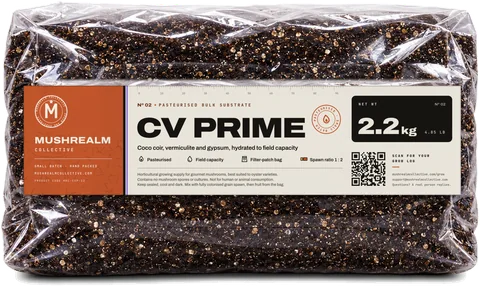
CV Prime is coir and vermiculite, the original MushRealm ACS recipe: the exact blend ACS, our grower, runs in every grow. It arrives pasteurised and hydrated to field capacity, so there is nothing to measure or adjust. You mix colonised grain into the bag and fruit from it, which leaves you free to focus on what really drives yield: spawn rate and fruiting conditions.
The short version
- CVG is CV plus gypsum, usually about a cup per 650 g coir brick.
- Gypsum adds calcium and sulphur and may improve texture. It does not meaningfully change pH.
- Evidence for a yield boost on CV is mixed and mostly anecdotal.
- Spawn rate, moisture and fruiting conditions matter far more.
- Want to know for sure? Split a batch and weigh the harvests.
Frequently asked questions
What is CVG substrate?
Do you need gypsum in CV substrate?
How much gypsum do I add per coir brick?
Can I use lime instead of gypsum?
Is CVG better than CV for oyster mushrooms?