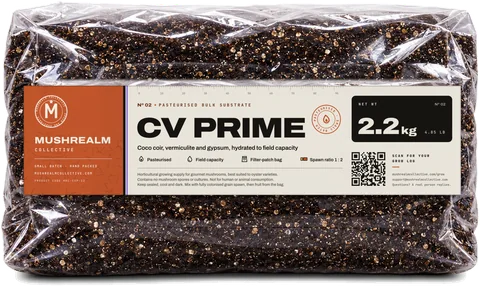
Masters mix comes up the moment you read past beginner oyster guides. Growers post photos of enormous clusters grown on it, and it is a go-to substrate for lion's mane and king oyster. So should you be using it instead of coir and vermiculite? It depends on the species and how you like to work. We sell CV Prime, a coir and vermiculite substrate, and we do not sell masters mix, so take that into account. Here is an honest look at both.
What masters mix is
Masters mix is a supplemented hardwood substrate:
- About 50:50 by dry weight of hardwood sawdust or hardwood fuel pellets and soya hulls, usually bought as pellets.
- Hydrated to around 60% moisture. When water is added, the pellets break down into a fluffy, sawdust-like mix.
- Packed into filter patch bags and pressure sterilised at 121°C (250°F) and 15 psi (about 1 bar), typically 2.5 hours or more for a 2.3 kg (5 lb) bag.
- Inoculated with colonised grain spawn, often around 10 to 20% of the substrate weight, in a still air box or in front of a flow hood, then sealed to colonise.
The sawdust gives structure and the wood fibres that wood-loving species are built to break down. The soya hulls add protein and other nutrients. Rich food means fast colonisation and heavy fruiting.
The catch is that everything that feeds your mushroom also feeds moulds and bacteria. That is why masters mix must be fully sterilised, not just pasteurised, and why it has to be opened only in clean, still air until it is fully colonised.
Buying tips if you make it: use pellets labelled 100% hardwood with no additives, and check the label carefully because softwood and mixed pellets are common in some areas. Soya hull pellets are sold as livestock feed.
Which mushrooms want masters mix
- Oysters love it. Blue, pearl and the other common oysters colonise it fast and fruit heavily. They do not need it, though, as the CV section below explains.
- King oyster does best on supplemented hardwood such as masters mix and fruits poorly on coir and vermiculite.
- Lion's mane is a wood lover, and masters mix is one of the most popular substrates for it. Our lion's mane guide covers growing and cooking it.
- Shiitake grows on supplemented hardwood, including masters mix, but needs a long incubation and a browning stage before it fruits, so expect a slow grow. See our shiitake growing guide.
Other wood lovers, such as maitake and reishi, also fruit best on supplemented hardwood sawdust, often with a recipe tuned to the species.
CV vs masters mix at a glance
| CV (coir and vermiculite) | Masters mix | |
|---|---|---|
| What is in it | Coconut coir and vermiculite | Hardwood sawdust or pellets and soya hulls, about 50:50 |
| Nutrient level | Low | High |
| Heat treatment | Pasteurised, roughly 60 to 80°C (140 to 176°F) | Sterilised, 121°C (250°F) at 15 psi |
| Equipment | None if bought ready-made | Pressure cooker or steam steriliser, filter patch bags |
| Handling when spawning | Clean hands and surfaces, work quickly | Still air box or flow hood |
| Contamination tolerance | Forgiving | Unforgiving if handling slips |
| Best species | Oysters (blue, pearl, pink, golden); also a casing layer | Oysters, king oyster, lion's mane, shiitake |
| Typical spawn rate | Generous: about 1 : 2 grain to substrate | Lower: often 10 to 20% of substrate weight |
| Harvest per bag | Good, with much of the food coming from the grain | Heavy |
| Where to get it | Ready-made, or coir bricks plus vermiculite | Mostly homemade from pellets |
Why CV is the easier bulk for oysters
Low nutrients work in your favour. Coir and vermiculite give moulds and bacteria very little to eat, so pasteurisation is enough. Pasteurising knocks back competitors without sterilising, and leaves a bulk that does not invite trouble the way rich, sterile substrate does.
No pressure cooker, no flow hood. You can spawn CV in an ordinary clean room with wiped surfaces, washed hands and a few minutes of work. With masters mix, a brief lapse during spawning is often enough to lose the bag.
Oysters do not need the extra food. Oyster mycelium is fast and aggressive. Given plenty of colonised grain, it claims a CV bulk quickly and fruits well. Because CV supplies little nutrition of its own, the grain does much of the feeding, which is why CV is spawned generously.
It is simple to fruit. With CV Prime, you mix colonised grain into the bag, let it colonise and fruit from the same bag, often with a second flush afterward. CV also makes a good casing layer.
What you give up: harvest size. A bag of masters mix will usually out-produce the same size bag of CV, because it carries far more food. If you are chasing the biggest possible oyster harvest and already have a pressure cooker and a still air box, masters mix is worth trying.
Where CV is the wrong choice: lion's mane, king oyster, shiitake and other wood lovers fruit poorly on it. For those, use a supplemented hardwood such as masters mix. We do not sell sawdust substrates, but colonised grain spawn from us can be used to spawn masters mix, other sawdust blends or logs you prepare yourself.
Making masters mix at home: the outline
- Weigh equal parts hardwood fuel pellets and soya hull pellets, for example 1 kg (2.2 lb) of each.
- Hydrate to about 60% moisture. Roughly 1.2 to 1.4 litres of water per kilo of pellets (about 1.3 to 1.5 quarts per 2.2 lb) is a common starting point. Let the pellets break apart, mix well, then check that a hard squeeze gives only a few drops.
- Bag the mix in filter patch bags and fold or seal the tops.
- Sterilise at 15 psi, about 2.5 hours or more for 2.3 kg (5 lb) bags, then let them cool completely.
- Spawn with fully colonised grain in a still air box or in front of a flow hood, seal, and mix.
- Colonise at the temperature your species prefers, then open or cut the bag to fruit.
Our pasteurised vs sterilised substrate guide explains the difference between the two heat treatments in more depth.
Which should you choose?
- Oysters, first few grows, no pressure cooker: CV. It is the forgiving, pasteurised option and fruits straight from the bag.
- Lion's mane, king oyster or shiitake: masters mix or another supplemented hardwood. Plan for sterilising and clean handling.
- Experienced oyster grower chasing yield: try masters mix alongside CV and compare.
For a wider view of the options, see mushroom substrate types, what CV substrate is and our buyer's guide on how to choose a mushroom substrate.
The short version
- Masters mix is about 50:50 hardwood sawdust or pellets and soya hulls, hydrated and fully sterilised.
- It is rich and productive, and suits lion's mane, king oyster, shiitake and oysters.
- It needs a pressure cooker and a still air box or flow hood.
- CV is low in nutrients, pasteurised and forgiving: the easier bulk for oysters.
- Masters mix usually yields more per bag; CV trades some yield for simplicity.
- We sell CV, not masters mix. Our grain spawn can spawn either.
Frequently asked questions
What is masters mix made of?
What is the best substrate for lion's mane?
Can you pasteurise masters mix instead of sterilising it?
Is CV or masters mix better for oyster mushrooms?