Lion's mane (Hericium erinaceus) grows as a single white head of cascading, icicle-like spines, and it is one of the most rewarding gourmet mushrooms to grow. It is also a wood lover, so it asks a bit more of you than oysters do. This guide covers both halves: how to grow it from grain spawn to harvest, and how to cook it so the texture shines.
What lion's mane needs
Lion's mane breaks down hardwood in the wild, and it fruits best on hardwood sawdust enriched with bran. That has two consequences:
- The substrate must be sterilised, not just pasteurised. The bran that feeds lion's mane also feeds moulds and bacteria.
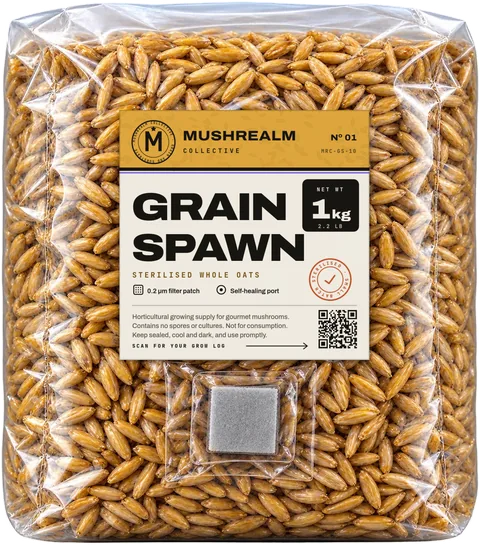
- Coir and vermiculite is not the right bulk. Our CV Prime is made for oysters, and we do not sell sawdust. What we do sell, sterilised grain bags, is the usual starting point: colonise the grain with lion's mane, then use it to spawn sawdust blocks.
| Stage | Temperature | Humidity | Typical time |
|---|---|---|---|
| Grain colonisation | 21 to 24°C (70 to 75°F) | Sealed bag | 14 to 28 days |
| Block colonisation | 21 to 24°C (70 to 75°F) | Sealed bag | 14 to 21 days |
| Pinning to harvest | 18 to 24°C (64 to 75°F) | 85 to 95% | 10 to 14 days |
| Rest before next flush | Room temperature | Normal | 7 to 14 days |
How to grow lion's mane, step by step
1. Colonise the grain
Inoculate a sterilised grain bag with live lion's mane mycelium, such as a commercial grain spawn of the species, a colonised grain transfer from a previous bag or a liquid inoculant, through the self-healing injection port. Our guide to inoculating grain spawn bags walks through it.
Keep the bag at 21 to 24°C (70 to 75°F) in low light. Lion's mane mycelium is thin and wispy compared with oyster, so a fully colonised bag can look patchy. That is normal. Small white bumps forming in the bag are a sign it is ready, and eager, to fruit.
2. Prepare supplemented sawdust blocks
A reliable home recipe:
- Hardwood sawdust or hardwood fuel pellets (oak, beech or maple are all good)
- Wheat bran at 10 to 20% of the dry weight
- Water to about 60% moisture: a squeezed handful should release only a few drops
A popular alternative is a 50:50 mix of hardwood pellets and soybean hulls, often called Master's Mix, which lion's mane grows on well. Pack 2 to 2.5 kg (4.4 to 5.5 lb) into filter patch grow bags and sterilise them, typically about 2.5 hours at 15 psi (about 1 bar) in a pressure cooker for blocks that size. Let them cool completely before spawning. If you would rather skip this step, ready-sterilised blocks are sold by many suppliers.
3. Spawn the blocks
In a clean space, add colonised grain at about 10 to 20% of the block's wet weight: roughly 250 to 500 g (0.5 to 1 lb) for a 2.5 kg block. Break the grain up, mix it through, seal the bag and shake to distribute. More spawn means faster colonisation and fewer chances for contamination. Our spawn to bulk guide explains the trade-offs.
4. Colonise the block
Leave the block sealed at 21 to 24°C (70 to 75°F) for two to three weeks. Expect a white haze through the sawdust rather than a solid white brick. When you see small white knots pushing against the plastic, it is time to fruit.
Fruiting conditions and troubleshooting
Lion's mane likes to fruit from a single small opening, which gives you one big head rather than lots of small ones.
- Cut a small X or slit, 2 to 5 cm (1 to 2 in) long, in the bag where pins are forming.
- Move the block to 18 to 24°C (64 to 75°F) with 85 to 95% humidity, indirect light and fresh air several times a day. Our guide to mushroom fruiting conditions covers simple setups.
- Mist the air and container walls, not the head itself. Water sitting on the spines can cause discoloured patches.
| What you see | Likely cause | Fix |
|---|---|---|
| Branching, coral-like growth with few spines | Too little fresh air | Increase air exchange |
| Short, stubby spines and a dry, yellowing crust | Humidity too low | Raise humidity, keep the slit area moist |
| Spines yellowing quickly on a large head | Over-mature | Harvest now |
| No pins after two weeks of fruiting | Not fully colonised, or too warm | Wait, and drop the temperature a few degrees |
When to harvest lion's mane
Harvest when the head is firm and bright white and the spines have lengthened to about 0.5 to 1 cm (1/4 to 3/8 in). Do not wait for it to keep growing: once the spines turn yellow or brown, the texture gets tougher and the flavour can turn bitter.
Cut the head off flush with the bag using a clean knife. A second flush usually forms from the same opening 10 to 14 days later, and most blocks give two or three flushes, each smaller than the last. See how to get a second flush.
Foraging and the law
In Great Britain, wild lion's mane is a protected species. It is listed on Schedule 8 of the Wildlife and Countryside Act 1981, which makes it an offence to intentionally pick, uproot or destroy it. If you are lucky enough to find one on an old beech or oak, photograph it and leave it where it is. Growing your own is the legal way to eat lion's mane.
Wherever you are, never eat a wild mushroom unless its identity has been confirmed by an experienced local expert. Some deadly species look like edible ones.
How to cook lion's mane
Lion's mane is mild, slightly sweet and savoury, with a stringy, tender texture that pulls apart like crab. It is full of water, so the secret is to drive that water out before adding fat. Always cook it: the texture and flavour only come through with heat.
Prep: do not wash it. Brush off any bits of substrate and trim the base. Slice into slabs 1.5 to 2 cm (about 3/4 in) thick, or tear into pieces along the grain.
Pan-seared lion's mane steaks
- Heat a heavy frying pan over medium-high heat with no oil.
- Add the slabs and press them with a spatula or a second pan. Water will hiss out. Cook 3 to 4 minutes a side until golden and dry.
- Add a tablespoon of butter or a splash of oil, a crushed garlic clove and a few sprigs of thyme. Baste for 1 to 2 minutes.
- Season with salt at the end and finish with lemon juice.
Lion's mane crab-style cakes
Ingredients (4 cakes): 250 g (9 oz) lion's mane, 1 egg, 2 tbsp mayonnaise, 1 tsp Dijon mustard, 40 g (about 3/4 cup) panko breadcrumbs, 1 tsp seafood seasoning or smoked paprika, zest of half a lemon, 2 tbsp chopped parsley, 1 spring onion, salt, pepper and oil for frying.
- Shred the lion's mane into thin strands and dry-sauté for 5 to 6 minutes until the moisture has cooked off. Cool, then squeeze out any remaining liquid.
- Mix with everything except the oil, and shape into four patties.
- Chill for 15 minutes so they hold together.
- Fry in a thin layer of oil for 3 to 4 minutes a side until deep golden. Serve with lemon wedges and tartare sauce.
More ways to use it
- Torn into pieces in place of chicken in a stir-fry.
- Pan-seared and tossed through pasta with butter, lemon and parsley.
- Roasted at 200°C (400°F) for 20 to 25 minutes with olive oil and salt.
Fresh lion's mane keeps about 4 to 6 days in a paper bag in the fridge, and cooked lion's mane freezes well. More in our guide on how to store fresh mushrooms.
The short version
- Lion's mane is a wood lover: grow it on sterilised, supplemented hardwood sawdust, not coir.
- Colonise a grain bag first; expect thin, wispy mycelium.
- Spawn sawdust blocks at 10 to 20% grain, colonise at 21 to 24°C (70 to 75°F).
- Fruit from one small slit at 18 to 24°C (64 to 75°F), 85 to 95% humidity, with plenty of fresh air.
- Harvest while bright white, before the spines yellow.
- Dry-sear it in slabs or shred it for crab-style cakes.
- In Great Britain, never pick it from the wild. It is protected by law.
Frequently asked questions
Can you grow lion's mane on coco coir?
When should I harvest lion's mane?
What does lion's mane taste like?
Is it legal to pick wild lion's mane in the UK?