Mushroom foraging is one of the best reasons to get outside in the fall, but it is the one wild food hobby where a beginner's mistake can be fatal. The good news: the safe way to start is also the most enjoyable. You learn with other people, you learn slowly, and you treat every unknown mushroom as dangerous until an expert says otherwise. Here is how we would start if we were new to it.
The golden rule: no expert, no eating
Never eat a wild mushroom unless its identity has been confirmed by an experienced local expert, in person, with the actual mushroom in front of them. Not a photo, not an app, not a confident stranger online.
The reason is simple. Some of the deadliest mushrooms look very like edible ones. The death cap and the destroying angels contain toxins that are not destroyed by cooking, freezing or drying, and symptoms often don't start until 6 to 24 hours after the meal, by which time the liver is already being damaged. Our guide to deadly mushroom lookalikes covers the species every forager in your region should know on sight.
A few habits that follow from this:
- If in doubt, throw it out. Every feature has to match, not most of them.
- Learn the killers first. You can't rule something out if you don't know what it looks like.
- Keep unknowns separate. Never put an unidentified mushroom in the same basket section as your edibles.
- First time eating a confirmed edible: cook it thoroughly, eat a small amount, don't mix it with other new species, and keep one uncooked specimen in the refrigerator in case anyone feels unwell.
Find your people: groups, clubs and societies
The fastest and safest way to learn is to walk with people who have been doing this for decades.
In the US, start with the North American Mycological Association (NAMA). Its website lists affiliated clubs across the country, and most regions have at least one. Local clubs run group forays, identification tables where members bring finds to be named, and annual mushroom shows. NAMA also has volunteer identification consultants who help poison centers and hospitals with suspected poisonings, which tells you how seriously the community takes identification.
Club forays are usually cheap or free for members, and the people at the ID table have seen your region's lookalikes many times over. That local knowledge matters: a mushroom that is a safe edible in one part of the country can have a dangerous lookalike in another.
Your foraging kit
You don't need much, and most of it you may already own.
| Item | Why it matters |
|---|---|
| Flat-bottomed wicker basket | Air flows through, mushrooms don't crush, and some debris falls out as you walk |
| Paper bags or waxed paper | Keeps each species separate, especially unknowns |
| Small knife | Clean cuts and trimming dirt in the field |
| Soft brush | Brushing off soil and needles so your basket stays clean |
| Regional field guide (more than one is better) | Read the poisonous species pages first |
| Hand lens (10x) | Seeing gill edges, stem texture and small details |
| Phone | Photos of every angle, location notes, map |
Skip plastic bags. Mushrooms sweat and spoil fast in plastic, and a squashed mushroom is much harder to identify.
For your own safety, tell someone where you are going, wear long pants and check yourself for ticks afterwards (ticks carry Lyme disease on both sides of the Atlantic).
During hunting season, wear blaze orange in the woods, and check whether the area you plan to visit is open to hunters that day.
How to look at a mushroom properly
Beginners look at the cap. Experienced foragers look at everything else. When you find something, work through it in this order:
- Where is it growing? On soil, on wood, on a living tree, in grass? Under which trees? Alone, scattered, in a ring or in a tight cluster?
- Cap: size, shape, color, surface (smooth, scaly, sticky, velvety), and whether the edge is rolled in or wavy.
- Underside: gills, pores, teeth or blunt ridges? If gills, are they crowded or spaced, attached to the stem or free, and what color are they?
- Stem: solid or hollow, smooth or scaly, any ring or skirt?
- Base: ease the whole mushroom out of the ground. A sack-like cup (volva) at the base is a key sign of the deadly Amanitas, and it is often hidden below the soil or leaf litter.
- Flesh: cut it in half. Note the color, and whether it changes color or stains where cut or bruised.
- Smell: mealy, fruity, aniseed, inky, radish-like, or nothing at all.
- Season: what month is it, and has it rained recently?
Photograph the top, underside, side, base and cut flesh before you leave, then ask yourself the most important question in foraging: what else could this be?
Learn a few species really well
Don't try to learn fifty mushrooms. Pick three to five distinctive species that grow near you, and learn each one, plus its lookalikes, across a full season. Here are common first targets, all to be confirmed with an expert before eating:
| Species | Season | Where | Rule out |
|---|---|---|---|
| Chicken of the woods | Late spring to fall | Shelves on hardwoods, especially oak | Gilled orange mushrooms on wood. Many foragers avoid ones on conifers, eucalyptus or locust |
| Hen of the woods (maitake) | Late summer to fall | Base of oak trees | Other large polypores at tree bases |
| Giant puffball | Late summer to fall | Lawns, meadows, woodland edges | Cut top to bottom: pure white all through, with no outline of a cap or gills inside (a young Amanita) |
| Morels | Spring | Around dying elms, ash, old orchards, burn sites in the West | False morels. True morels are hollow from cap tip to stem base |
| Oyster mushrooms | Fall to spring | Dead hardwood logs and stumps | Other pale shelf mushrooms on wood |
Our mushroom foraging calendar shows when each one appears, and the chicken of the woods guide is a good first deep dive.
Pick sustainably and legally
A mushroom is the fruit of a much larger organism living in the soil or wood. Picking with care keeps patches productive for years.
- Take only what you will eat fresh. Leave young buttons to grow and old ones to do their job. Wildlife and insects need them too.
- Cut cleanly or twist gently. When you need the base for identification, ease it out carefully rather than ripping it up.
- Don't rake, dig or trample. Disturbing leaf litter and compacting the ground does more harm than picking.
- Avoid polluted spots. Skip roadsides, sprayed lawns and dog-walking hot spots, since mushrooms can take up pollutants.
- Leave rare and protected species alone. Some parks and reserves protect all fungi.
- Check permission first. Rules vary by landowner and site, and some places ban picking outright. Read our mushroom foraging laws guide before you go.
Your first season: a simple plan
- Join a local group and go on at least two or three group forays.
- Buy a regional field guide and read the poisonous species section first.
- Learn to recognize the death cap and destroying angel on sight, plus the regional killers.
- Choose three target edibles that are in season near you.
- Photograph and take notes on everything you find, edible or not, and key it out at home.
- Bring your finds to an expert. Only eat something after an experienced local expert has confirmed it in person, and start with a small, well-cooked portion.
- Keep a foraging journal: date, place, weather and host trees. Patches often fruit in the same spots year after year.
Want a sure thing? Grow some at home
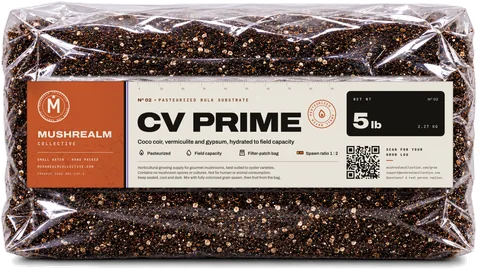
Foraging is seasonal and uncertain, and that is part of its charm. If you simply want fresh gourmet mushrooms on the table with zero identification risk, growing them is the safe, year-round option. Oyster mushrooms are the easiest place to start: see our guide to the easiest mushrooms to grow at home, or start with our grow kit, which pairs a sterilized grain bag with CV Prime substrate: you add live oyster mycelium and a spot with fresh air.
Quick checklist
- Never eat a wild mushroom unless an experienced local expert has confirmed it in person.
- Join a local mycological club (NAMA lists them) and learn in the field.
- Learn the deadly species before the edible ones.
- Carry a basket, paper bags, a knife, a brush and a regional field guide.
- Check every feature: habitat, cap, underside, stem, base, flesh and smell.
- Pick only what you will eat, leave the rest, and check the local rules.
- Cook wild mushrooms thoroughly and try a small amount first.
Frequently asked questions
Is mushroom foraging safe for beginners?
Can I use an app to identify wild mushrooms?
What is the best wild mushroom for beginners to learn?
How many mushrooms can I pick when foraging?
Do I need permission to forage for mushrooms?