Search for a CV recipe and you will find a dozen versions that don't quite agree. That's normal: coir bricks expand differently, vermiculite grades differ, and people measure in cups, quarts and liters. Below are the figures most growers start from, how to scale them, the full bucket method, and the squeeze test that makes the final call.
The standard ratio
The common rule is 1 part expanded coir to 1 part dry vermiculite, by volume, with enough boiling water to bring the whole lot to field capacity. For one standard brick, the typical figures are:
| Ingredient | Typical amount | Notes |
|---|---|---|
| Coco coir | 1 brick, 650 g (1.4 lb) | Expands to about 7.5 L; varies by brand |
| Vermiculite, coarse or medium | About 7.5 to 8.5 L (8 to 9 US quarts) | Measured dry, by volume |
| Boiling water | About 4 to 4.5 L (roughly 4.25 to 4.75 US quarts) | Add in stages, finish with a squeeze test |
| Gypsum (optional) | About 1 US cup (240 mL) | Turns CV into CVG |
Treat every number as a starting point. Your coir may be drier or more tightly packed than ours, and the squeeze test, not the recipe, decides when the water is right. If you are wondering whether the gypsum is worth it, see CV vs CVG substrate.
Watch the units
Some published recipes use far less vermiculite: around 8 US cups (about 1.9 L) per brick, with about 3.8 L (16 cups) of water. "8 cups" and "8 quarts" differ by a factor of four, and both turn up online.
Both mixes grow oysters. The full 1:1 version is lighter, airier and holds more water in reserve. The low-vermiculite version is denser and mostly coir. Whichever you follow, check which unit the recipe means before you start pouring.
Measuring by weight
Weighing makes batches repeatable, but only some ingredients weigh well:
- Coir is easy. Bricks are sold by weight, so one brick is 650 g.
- Water is easy. 1 L weighs 1 kg, so 4 to 4.5 L is 4 to 4.5 kg (8.8 to 9.9 lb), roughly six to seven times the weight of the dry coir.
- Vermiculite is better measured by volume. It is very light, and its weight per liter changes with grade and with how damp the bag is, so a recipe written in grams doesn't transfer well between brands.
The most useful weight trick is to record your own result. Put the bucket on a scale (a bathroom scale works) and zero it, make a batch, adjust it until it passes the squeeze test, then weigh it. Next time, use the same coir and vermiculite, add water until you reach the same total, and you will land at field capacity without guessing. A one-brick batch usually finishes somewhere around 5 to 6 kg (11 to 13 lb).
Scaling the recipe: a quick calculator
Scale everything in proportion to the coir. A 5-gallon (19 L) bucket holds a one-brick batch with room to stir. For two bricks or more, use a larger lidded tote or several buckets.
| Batch | Coir | Vermiculite | Boiling water | Finished weight (approx.) |
|---|---|---|---|---|
| Half brick | 325 g (0.7 lb) | 3.75 to 4.25 L | 2 to 2.25 L | 2.5 to 3 kg (5.5 to 6.6 lb) |
| 1 brick | 650 g (1.4 lb) | 7.5 to 8.5 L | 4 to 4.5 L | 5 to 6 kg (11 to 13 lb) |
| 2 bricks | 1.3 kg (2.9 lb) | 15 to 17 L | 8 to 9 L | 10 to 12 kg (22 to 26 lb) |
| 3 bricks | 1.95 kg (4.3 lb) | 22.5 to 25.5 L | 12 to 13.5 L | 15 to 18 kg (33 to 40 lb) |
How much do you actually need?
Work backwards from your grain. At a 1:2 spawn ratio by weight, every 1 kg (2.2 lb) of grain spawn needs about 2 kg (4.4 lb) of CV; at 1:4 it needs about 4 kg (8.8 lb). So a one-brick batch suits roughly 2.5 to 3 kg (5.5 to 6.6 lb) of grain at 1:2, or about 1.5 kg (3.3 lb) at 1:4.
Our grain and substrate planner does this math for any number of grows and any spawn ratio, and the spawn to bulk guide explains how to pick the ratio in the first place.
Step by step: the bucket method
You need a lidded bucket, a kettle or large pot, a long clean spoon or gloved hands, a towel or old blanket, and ideally a probe thermometer. Wear a dust mask when pouring dry vermiculite.
- Clean the bucket. Wash it with hot soapy water and rinse it well.
- Add the coir brick. Drop it in whole or break it into chunks.
- Add the vermiculite on top, plus gypsum if you are making CVG.
- Boil the water and pour in about 4 L, holding the rest back.
- Lid on straight away. Wrap the bucket in a towel or blanket and leave it 30 to 60 minutes so the brick softens.
- Break it up and stir. Open the lid briefly, break up any lumps of coir with the spoon and mix until the color is even. Put the lid back quickly to keep the heat in.
- Check the heat (optional). Right after stirring, a probe thermometer in the center should read at least 60°C (140°F). Boiling water poured over the dry mix brings it into the pasteurization range of 60 to 80°C (140 to 176°F), and the insulated bucket holds it there while it slowly cools.
- Leave it to cool for 6 to 8 hours or overnight, without opening the lid, until it is at room temperature and below about 27°C (80°F).
- Squeeze test. Squeeze a handful hard: a few drops should appear. If it is dry and crumbly, add a little boiled and cooled water, mix and test again. Field capacity explained covers the test and the fixes in detail.
- Spawn it with colonized grain, ideally the same day.
This gentle heat is enough because CV is so low in nutrients. Why grain needs a pressure cooker while CV doesn't is covered in pasteurized vs sterilized substrate.
Common CV mistakes
| Problem | Likely cause | Fix |
|---|---|---|
| Water pooling in the bottom | Too much water added at once | Drain it, or mix in dry vermiculite |
| Dry, dusty patches | Brick not fully broken up | Stir harder at step 6, add a little water |
| Grain struggles after mixing | CV still warm | Wait until it is below 27°C (80°F) |
| Dense, soggy mix | Fine-grade vermiculite, or too little of it | Use coarse or medium grade |
| Contamination soon after spawning | Potting coir with added fertilizer, or CV left standing for days | Buy plain coir with nothing added; spawn within a day of cooling |
| Recipe "doesn't work" | Cups and quarts mixed up | Check the units |
Or skip the bucket entirely
If you only run a grow or two at a time, a whole-brick batch is a lot of substrate, and the overnight wait and the moisture guessing are extra places for things to go wrong.
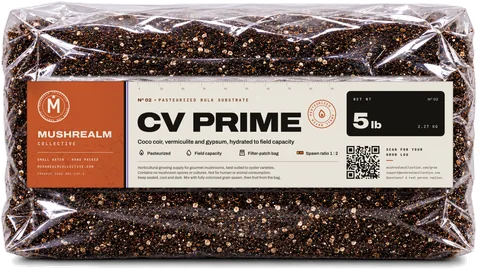
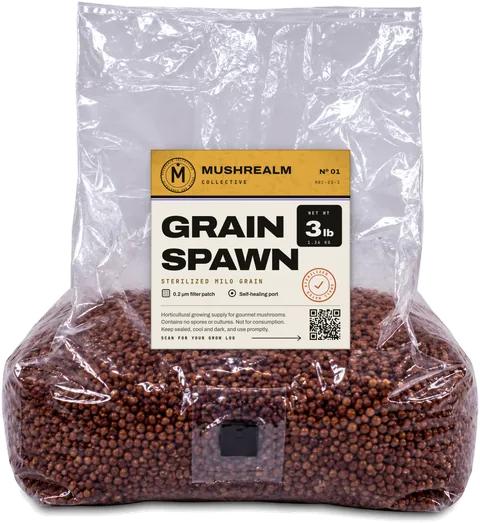
CV Prime skips all of it. It is coir and vermiculite, the original MushRealm ACS recipe, pasteurized and hydrated to field capacity in a bag you mix grain into and fruit from. A 5 lb bag pairs with a 3 lb milo grain bag at roughly 1:2 by weight, and our grow kit puts the two together.
DIY still makes sense if you run many grows at once or simply enjoy the process.
Quick checklist
- One 650 g coir brick, about 7.5 to 8.5 L vermiculite and about 4 to 4.5 L boiling water.
- Check whether a recipe means cups or quarts.
- Lid on, insulate, stir once the brick softens, then leave it 6 to 8 hours.
- Spawn only when it is below 27°C (80°F).
- Squeeze test: a few drops, never a stream.
- Use the planner to size the batch to your grain.
Frequently asked questions
What is the ratio of coco coir to vermiculite for mushrooms?
How much water do I add to a coir brick and vermiculite?
How long does CV substrate take to cool after pasteurizing?
Is there a coco coir vermiculite calculator?