The first harvest is not the end of a grow. A colonised block still has food left after flush one; what it is short of is water. Put that back and it will usually fruit again, often two or three more times. Here is the routine we use on the MushRealm bench for CV grows, plus how to tell when a block has given all it has.
Why the block slows down after the first flush
Mushrooms are about 90% water, and nearly all of it comes out of the substrate. A good first flush leaves the block noticeably lighter and drier. The mycelium is alive and still has nutrition to draw on, but without water it can't build new mushrooms.
Each flush also uses up some of that nutrition, which is why flushes shrink over time. In a CV grow, much of the food is in the grain spawn, so the spawn ratio matters: a 1:1 or 1:2 mix generally has more to give in later flushes than a 1:3 mix (see the spawn to bulk guide).
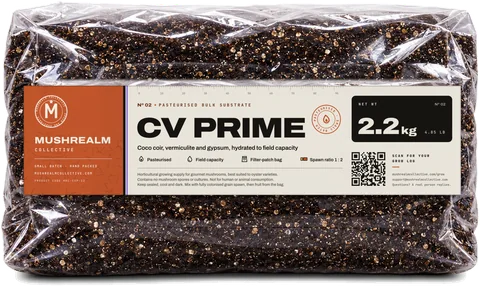
Coir is very good at soaking water back up, which is one reason a coir and vermiculite mix like CV Prime handles rehydration so well.
Step 1: Harvest cleanly
- Pick each cluster whole at its base, by twisting it off or cutting it flush with a clean knife.
- Remove every stub, aborted pin and broken piece. Leftovers rot and give mould a place to start.
- Don't dig into the block. Scraping the surface damages the mycelium that will make the next flush.
- If you weighed the block before fruiting, weigh it again now. The difference shows how much water to put back.
Weighing each block just before it goes into fruiting makes rehydration much more precise, so it is a good habit to start with your next grow.
Step 2: Rest the block
Keep the block covered in its usual spot for 2 to 5 days. Over the rest, the surface often turns white again as the mycelium recovers.
If pins start forming during the rest and the block still feels heavy, skip the soak and go straight back to fruiting. If it feels light, or the surface looks dry and tight, soak it.
Step 3: Rehydrate the substrate
Dunking a block or slit grow bag
- Fill a clean bucket, sink or large pot with cold tap water. The cold is a mild pinning signal too.
- Submerge the block, or the whole grow bag; water gets in through the slits.
- Weigh it down with a plate or a zip-lock bag of water so it stays under.
- Leave it for 6 to 12 hours. Overnight is typical. Much longer raises the risk of bacteria.
- Drain it thoroughly: tip out all free water and let it drip for 15 to 30 minutes. No standing water should be left in the bag.
Soaking a tray or fruiting container
- Pour cold water over the surface until it is covered by 1 to 2 cm (1/2 to 3/4 in).
- Press the block down with a clean plate or a water-filled bag, because it will try to float.
- Leave it for 6 to 12 hours.
- Tip out every drop of free water and dab any puddles with a clean sheet of kitchen roll.
How much water to put back
The aim is to bring the block back close to its weight before the first flush. Weigh it after the soak, and if it is still well short, give it a few more hours. If you didn't weigh it, squeeze a pinch from the edge: a few drops means it is at field capacity, a stream means it is too wet. Our field capacity guide explains the test.
Step 4: Back to fruiting conditions
Return the block to the same humidity, fresh air, light and temperature as the first flush (see fruiting conditions). Pins usually appear 7 to 14 days after the soak. With grow bags, oysters often come from the old slits, and you can cut one or two fresh slits on another side.
Harvest as before, then repeat the rest and soak for flush three.
How many flushes to expect from CV
| Flush | Typical timing | What to expect |
|---|---|---|
| First | 1 to 2 weeks after fruiting begins | The largest and most even flush |
| Second | 7 to 14 days after the soak | Noticeably smaller |
| Third | 7 to 14 days after the next soak | Smaller again; worth it if the block is clean |
| Fourth and beyond | Possible | Usually small; keep going only if the block is clean and firm |
Most CV grows give 2 to 4 flushes. Clean technique and a richer spawn ratio tend to stretch that; a warm room or poor drainage shortens it. Our yield and biological efficiency guide shows how to measure what each block actually produced.
When to retire the block
Stop and clear it out when you see any of these:
- Green, black or any other coloured mould patch. Trichoderma often shows up on tired blocks.
- A sour, ammonia-like or rotten smell, or a slimy surface.
- The block shrinking away from the sides, or the mycelium turning yellow, brown or soft.
- Two weeks in fruiting conditions after a soak with no pins.
- Flushes so small they aren't worth the space.
- Fungus gnats hovering around it.
Spent CV still has uses. It makes good compost and garden mulch, and a spent oyster block buried in a shady, damp bed sometimes throws one last flush outdoors. Read what to do with spent mushroom substrate for more ideas. Never break open a mouldy block indoors; seal it in a bag and take it straight outside.
The short version
- Pull every stub after harvest.
- Rest the block for 2 to 5 days.
- Soak it in cold water for 6 to 12 hours, then drain it completely.
- Get it back near its pre-fruiting weight.
- Return it to fruiting conditions; pins follow in 7 to 14 days.
- Expect 2 to 4 flushes, and retire the block at the first mould or bad smell.
Frequently asked questions
How long after the first flush does the second flush come?
Do you have to soak a block for a second flush?
How many flushes can you get from CV substrate?
How do you rehydrate mushroom substrate?