Something has appeared on your substrate that is not the clean white of healthy mycelium. Before you panic, work out what it is. Some things that look alarming are perfectly normal, a couple of problems can be stopped if you catch them early, and a few mean the bag is finished. This guide covers bulk substrate and the fruiting stage. For trouble inside a grain bag before you spawn, see our grain spawn contamination guide.
What healthy mycelium looks like
Know the good stuff first, because most false alarms come from normal growth:
- Colour. Bright, clean white. Pink oyster mycelium can carry a faint pink tint and golden oyster a faint yellow one. That is the variety, not a problem.
- Texture. Rope-like strands (rhizomorphic growth) and fluffy, cottony patches (tomentose growth) are both normal and often appear in the same bag.
- Behaviour. It grows out from the grain kernels and binds the substrate into a firm mass you can feel through the bag.
- Smell. Earthy, fresh and mushroomy. Never sour, sweet-rotten or like vinegar.
Three things worry new growers and are usually fine:
- Amber or yellow droplets on oyster mycelium are metabolites. They often show up when the bag is warm. Check your temperature, then leave it alone.
- Yellowing patches on older oyster mycelium are common as it ages or gets stressed.
- White fuzz at the base of oyster clusters or across the surface is aerial mycelium. It is a sign of too little fresh air, not contamination.
Green mould (Trichoderma)
Trichoderma is the green mould behind most failed home grows. It begins as a dense white patch, often roughly circular, that can look like especially vigorous mycelium. Within a day or two the centre turns bright emerald, then darker forest green, and the colour spreads outward. The green stage is powdery, and the powder is how it travels: every bump or squeeze sends it into the air.
It tends to start where the mushroom mycelium is weak: around a kernel that never colonised, in a wet pocket, or where the bag was opened in dusty air. Trichoderma can also attack mushroom mycelium directly, so a bag rarely recovers once it takes hold.
Blue-green patches that are smaller, slower and more defined are usually Penicillium. The verdict is the same.
What to do: seal it and bin it, unopened. Do not try to scrape out the green.
Cobweb mould and how it differs from fluffy mycelium
Cobweb mould is caused by a group of fungi, mostly Cladobotryum species. It is the contaminant most often confused with healthy growth, because both are white and fluffy. These are the tells:
| Cobweb mould | Fluffy (tomentose) mycelium | |
|---|---|---|
| Colour | Greyish white, dull | Bright, clean white |
| Texture | Very fine and airy, like gauze or a spider web | Dense, cottony, matted |
| Speed | Can cover a surface in a day | Spreads steadily over several days |
| Where it starts | A random patch on the surface or on a mushroom | Grows out from areas already colonised |
| Grip | Sits on top; strands lift away easily | Binds the substrate together |
| On mushrooms | Can swallow a cluster, which then rots | Only normal fuzz at the stem bases |
Cobweb mould loves high humidity with still air and water sitting on the surface. Caught early, it can sometimes be held back. Some growers spot-spray a small patch with 3% hydrogen peroxide, which usually collapses the wisps, then increase fresh air and stop misting the substrate directly. Treat that as a rescue attempt, not a cure. If it comes back, or covers more than a small patch, bin the bag.
Other moulds and bacteria
Green and cobweb moulds are the common ones. These are rarer, but each has a clear look, and none of them can be rescued.
Black, pin and orange moulds
- Pin mould (Rhizopus and Mucor) is fast, grey and hairy, with tiny dark dots on the tips of tall strands, like pins in a cushion. It usually means the substrate or the grain was too wet.
- Black mould (Aspergillus and others) appears as black, dark green or yellow-green powdery spots. Some Aspergillus species can irritate the lungs, which is one more reason never to open a contaminated bag indoors.
- Orange or pink powder is usually Neurospora. It grows extremely fast and spreads easily, so bin the bag at once and clean the area thoroughly. Do not confuse it with pink oyster, whose pale pink tint sits inside otherwise white mycelium and whose mushrooms are pink. Neurospora is bright orange and powdery.
All three: seal and bin.
Bacteria: wet spot, sour rot and bacterial blotch
Bacteria do not grow fuzz. They show up as wet, slimy, glistening or greasy patches, often yellowish or brown, with mycelium stopping dead at the edge. The smell gives it away: sour, like old socks, rotten fruit or vinegar. In substrate, the usual causes are too much water, burst grain carried over from the spawn, or a warm room. A bacterial bag will not recover, so bin it.
On the mushrooms themselves, bacterial blotch shows as yellow or brown sticky spots on the caps. It happens when water sits on the caps for hours. The bag itself is often fine: remove the spotted mushrooms, mist the walls and the air instead of the caps, and give more fresh air so surfaces dry between mistings.
Mushroom flies
Tiny dark flies around your fruiting area are usually fungus gnats or phorid flies. They are drawn to the smell of mycelium and mushrooms, especially in warm months, and their larvae tunnel through stems and caps.
- Harvest promptly and remove old mushrooms, stumps and offcuts.
- Cover any fresh-air holes with fine mesh or filter material.
- Hang yellow sticky traps near the fruiting area, not touching the mushrooms.
- Keep the area clean and dry outside the grow itself.
- Do not use insecticide sprays near food.
Mushrooms with tunnels in the stems should be discarded. A badly infested bag is best ended and the area cleaned.
Quick diagnosis table
| Sign | Likely cause | What to do |
|---|---|---|
| Bright or dark green powdery patch | Trichoderma green mould | Seal and bin, unopened |
| Small, slow blue-green patches | Penicillium | Seal and bin |
| Grey, wispy growth that spreads overnight | Cobweb mould | Spot-treat if tiny, add fresh air, bin if it returns |
| Tall grey hairs with black dots | Pin mould | Seal and bin |
| Black or yellow-green powder | Aspergillus or other black mould | Seal and bin, never open indoors |
| Bright orange or pink powder | Neurospora | Bin at once, clean the area |
| Wet, slimy, sour-smelling patch | Bacteria | Seal and bin |
| Yellow or brown sticky spots on caps | Bacterial blotch | Remove those mushrooms, mist the air not the caps |
| Tiny flies, tunnels in stems | Fungus gnats or phorid flies | Discard affected mushrooms, mesh, sticky traps |
| Amber droplets on mycelium | Metabolites (normal) | Check temperature, otherwise nothing |
| White fuzz at stem bases | Aerial mycelium from high CO2 (normal) | Add fresh air |
How to prevent substrate contamination
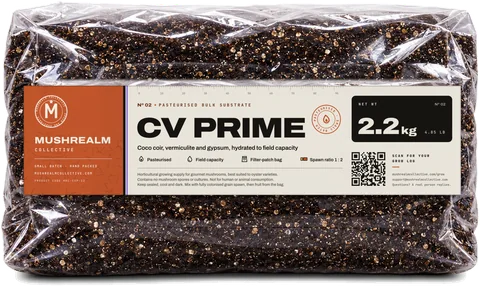
Coir and vermiculite has very little food in it for moulds, so most contamination in a CV grow traces back to the grain or to handling. That makes prevention fairly simple:
- Spawn only fully colonised, clean grain. One bad kernel mixed through a bag of substrate seeds the whole thing. Wait until the grain is white all the way through.
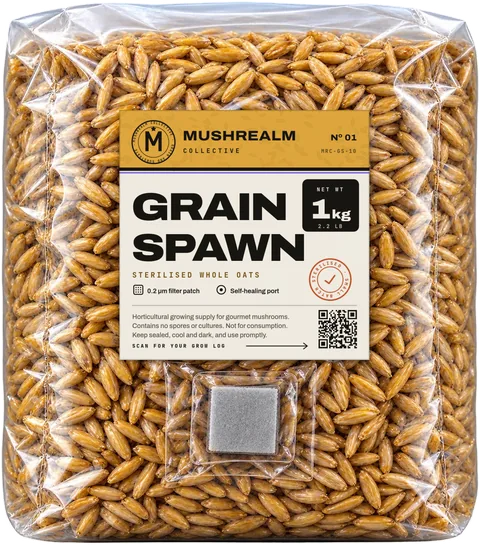
- Spawn generously. The more grain, the faster the mycelium claims the substrate. Our kits pair grain and CV Prime at about 1 : 2 by weight; the spawn to bulk guide explains why.
- Keep substrate at field capacity. A hard squeeze should give a few drops, not a stream. Water pooling in the bottom of a bag is an open invitation to bacteria. More in field capacity explained.
- Work clean. Wipe surfaces with 70% isopropyl alcohol, wash your hands, wear gloves, close windows, switch off fans and work quickly. Our clean technique guide covers the details.
- Colonise at the right temperature. For oysters that is about 20 to 24°C (68 to 75°F). A room above about 27°C (80°F) favours Trichoderma and bacteria over your mycelium.
- Do not peek. Keep bags closed while they colonise, and keep the filter patch dry and uncovered.
- Fruit with fresh air. Mist the walls and the air, empty any standing water, and remove old mushrooms. Our guide to mushroom fruiting conditions has the numbers.
When to bin a bag, and how
Throw a bag out when you see any green, blue-green, black, orange or pink powder, any slime, a sour or rotten smell, or cobweb mould that returns after treatment. Do not wait to see whether the mushroom mycelium wins. It rarely does, and the longer a mouldy bag sits in your grow space, the more it spreads.
- Do not open it. Not to look closer, not to smell it, and never indoors.
- Double-bag it. Slip the sealed bag into a second bag and tie it closed.
- Take it straight outside to your outdoor bin, well away from your grow space and any healthy bags.
- Clean up. Wipe the shelf where it sat with alcohol or a diluted bleach solution, wash your hands, and handle healthy bags before contaminated ones, never after.
If a bag from us arrives contaminated or damaged, send a photo within 7 days and we will replace or refund it. Details are on our returns page.
The short version
- Healthy mycelium is bright white, binds the substrate and smells earthy.
- Green, black, orange or pink powder means mould: seal and bin, unopened.
- Grey, wispy growth that appears overnight is cobweb mould: treat tiny patches early, bin if it returns.
- Slime and sour smells mean bacteria: bin.
- Sticky spots on caps mean water is sitting on them: mist the air, add airflow.
- Prevent it with fully colonised grain, a generous spawn rate, field capacity moisture, clean hands and fresh air.
Frequently asked questions
What does green mould on mushroom substrate mean?
How do I tell cobweb mould from mycelium?
Can I save a bag with green mould?
Are yellow droplets on oyster mycelium contamination?
Should I harvest mushrooms from a bag that has mould on it?