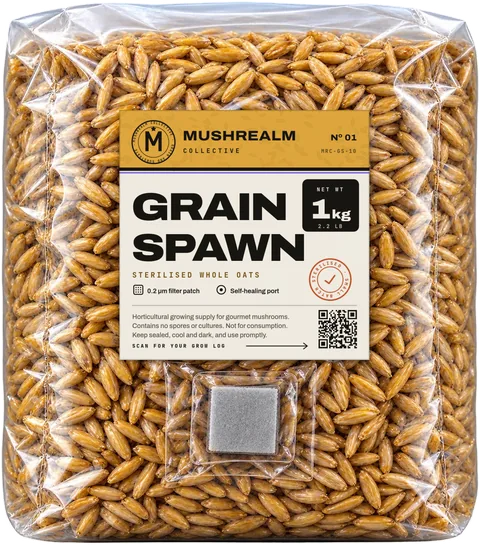
Rye is the grain you will find in most ready-made spawn bags sold in the UK, and it is the grain many growers learned on. So why does our bench fill its bags with whole oats instead? Not because rye is a bad grain. It is a very good one with one notable weakness. Here is a fair comparison of rye and whole oats, and why we went with oats.
Rye: why it is the classic
Rye berries are whole rye kernels. Unlike oats, rye threshes free of its husk, so you are working with a bare kernel: medium sized, long and plump once hydrated.
Rye has earned its reputation:
- It takes water readily, so the kernel hydrates evenly to the centre.
- It colonises fast. Mycelium of every common gourmet species runs through rye quickly.
- It is proven at scale. Commercial spawn producers have used it for decades, so its behaviour is well understood.
Its weakness is splitting. Without a husk, a rye kernel has only a thin seed coat between its starch and the water. Simmer it a few minutes too long, or let it sit too wet, and the kernels burst. Burst kernels leak sticky starch that glues the grain into clumps, slows colonisation and feeds bacteria. Experienced growers with their timing dialed in rarely have trouble. Newer growers often do.
Whole oats: the forgiving alternative
Whole oats are oats still in their husk, the kind sold as horse feed. That husk is the whole story:
- It protects the kernel. The husk acts like a jacket, so oats tolerate a few extra minutes of simmering without splitting.
- It hydrates quickly and evenly. Oats take on water readily, and much faster than milo.
- It breaks up cleanly. Colonised oats separate into loose kernels with a squeeze, which makes spawning to bulk quick and even.
The trade-offs: part of each oat's weight is husk, which is mostly fibre, so a kilo of oats carries a little less starch than a kilo of rye. For spawning a low-nutrient bulk like coir and vermiculite, that rarely matters. Oats can also be dusty, so rinse them until the water runs clear and skim off empty husks that float.
The form matters. Use whole oats only. Rolled, flaked, quick and steel-cut oats turn to paste, and hulled groats split more easily than whole oats.
Rye vs oats side by side
| Rye berries | Whole oats | |
|---|---|---|
| Kernel | Medium, long, bare (no husk) | Medium, long, in a husk |
| Inoculation points per kilo | Medium | Medium, similar to rye |
| Water uptake | Good, even | Fast and even |
| Bursting | High risk if over-simmered | Low to medium: the husk protects |
| Clumping | Common when kernels burst | Less common |
| Colonisation speed | Fast | Fast |
| Break-up when colonised | Good, if unburst | Very easy |
| Cost | Medium | Low |
| UK availability | Health food and bulk suppliers | Very easy: horse and farm feed |
| US availability | Health food stores, some feed stores | Feed and farm stores |
If you make your own: how the prep differs
The process is the same for both grains. What changes is how much margin you have.
- Rinse until the water runs clear. Skim off anything that floats.
- Soak overnight, roughly 12 to 24 hours, in cool water.
- Simmer gently. This is where rye needs care: check often, and stop as soon as a cut kernel is evenly moist with no hard, chalky core. Oats forgive a few extra minutes. Neither should be boiled hard.
- Drain and steam-dry on a rack or towel until the surface looks matte, not shiny. Wet surfaces cause most bacterial problems.
- Fill and sterilise at 15 psi (about 1 bar): around 90 minutes for 1 litre (1 quart) jars, longer for bags.
If you would rather skip all of that, our comparison of grain bags vs jars explains how ready-made sterilised bags remove the pressure cooker from the process.
Does the grain change your harvest?
Not in any way worth planning around. Oats, rye and milo all colonise well and all produce strong spawn. The things that actually change your results are getting the grain fully colonised before you use it, a generous spawn rate, substrate at the right moisture and good fruiting conditions. Our spawn to bulk guide and how long grain spawn takes cover those.
For a buyer, the practical difference between good rye, oat or milo bags is small. What matters more is how the grain was prepared. Look for loose, separate kernels, no water pooled in the bottom, and no sticky, split grain clinging to the plastic.
Why our bench chose oats
Our UK bench uses whole oats for three reasons. First, consistency: the husk makes oats hard to over-cook, so every batch comes out loose and evenly hydrated, which matters more to us than anything else. Second, break-up: colonised oats separate with a single squeeze, so spawning into CV Prime is quick and even. Third, supply: clean whole oats are easy to source in the UK as feed grain, so we are never at the mercy of a scarce ingredient.
Rye would work too. If you have a rye bag from a good maker, use it with confidence. We simply prefer the grain that leaves the least to chance.
Choosing for yourself
- Buying ready-made: any well-made bag of rye, oats or milo will colonise well. Judge the preparation, not the grain: loose kernels, no pooled water, an intact filter patch and an injection port.
- Making your own for the first time: start with whole oats or milo, because both resist splitting. Move to rye once your simmer timing is reliable.
- Comparing more grains: our best grains for mushroom spawn ranks seven, and the grain spawn contamination guide helps if a homemade batch goes sour.
If you want to skip the prep altogether, our grain spawn arrives hydrated and pressure sterilised, ready for live mycelium of a gourmet species through the injection port.
Quick checklist
- Rye is the classic: fast, proven, but splits if simmered too long.
- Whole oats are the forgiving choice: the husk protects the kernel and the grain breaks up cleanly.
- Never use rolled, flaked or steel-cut oats.
- Colonisation speed and harvests are similar; prep and moisture matter more than the grain.
- Buying ready-made, judge how the grain was prepared rather than which grain it is.
Frequently asked questions
Is rye the best grain for mushroom spawn?
Do you need to remove the husk from oats for grain spawn?
Why does my rye grain spawn clump?
Do oats or rye colonise faster?