Most mushroom growing equipment lists are written for people who make everything from scratch, which is why they open with a pressure cooker and finish with a flow hood. You need neither for your first harvest. The expensive gear exists to sterilise grain and pasteurise substrate. Buy those two things ready-made and the list shrinks to a handful of items from a supermarket or DIY shop.
Below are three tiers. Start at tier 1, grow a bag, and only move up when you know why you need the next piece.
Tier 1: the bare minimum (with ready-made bags)
Everything here fits on a kitchen shelf. With sterilised grain and pasteurised substrate, the only delicate step left is adding live mycelium through a self-healing port, which never opens the grain to the room.
| Item | What it does | Notes |
|---|---|---|
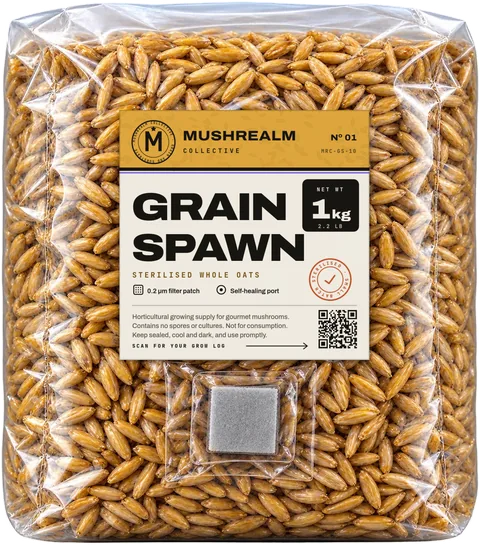
| Sterilised grain bag | Food for the mycelium; once colonised it becomes your grain spawn | Look for a filter patch and injection port, so it never needs opening |
| Live mycelium of a gourmet species | Starts the grow | A liquid inoculant, a commercial grain spawn of the species, or a colonised grain transfer from a previous bag |
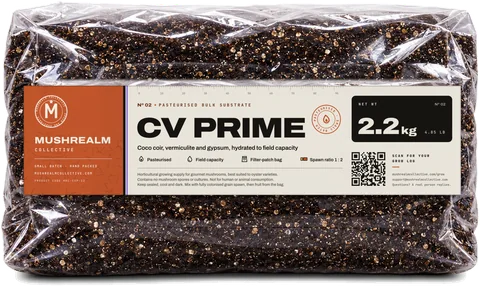
| Pasteurised bulk substrate | What the mushrooms fruit from | CV Prime comes hydrated to field capacity, so you add no water |
| 70% isopropyl alcohol | Disinfects gloves, the port and tools | Keep it in a spray bottle |
| Nitrile gloves | Keeps skin bacteria off the port and bag | One box lasts many grows |
| Paper towels | Wiping surfaces and the port | Lint-free if you can |
| Fruiting container, or the bag itself | Holds humidity while mushrooms grow | A substrate bag can be fruited by cutting slits or opening the top |
| Mister (spray bottle) | Keeps the surface and air humid | The finer the mist, the better |
| Clean scissors or a sharp knife | Opening bags and harvesting | Wipe with alcohol before use |
| Marker pen | Labels species and dates | You will forget which bag is which |
Our grain spawn comes as sterilised whole oats in a 1 kg bag, with a 0.2 micron filter patch and a self-healing injection port. CV Prime is our coir and vermiculite substrate, pasteurised and hydrated to field capacity, made to fruit from its own bag. The grow kit pairs the two at about 1:2 grain to substrate by weight (£27.99 for a 1 kg grain bag and 2.2 kg of CV Prime).
On alcohol strength: isopropyl alcohol (IPA) is often sold at 99% or more in the UK. Mix roughly 7 parts IPA with 3 parts distilled or boiled and cooled water to get about 70%. Stronger is not better: 70% stays wet long enough to work.
How the bag-only route works
- Wipe the injection port with alcohol and add live mycelium through it.
- Leave the bag in a dark or dim spot at about 20 to 24°C (68 to 75°F) until the grain is white all the way through. For oysters this often takes two to three weeks.
- Break up the colonised grain inside the closed bag. With clean gloved hands, open both bags, pour the grain into the substrate bag, fold the top over and clip it, then mix by massaging from the outside.
- Let it colonise again, usually one to two weeks for oysters.
- Cut slits or open the top, mist, and give it fresh air and indirect light. Pins often follow within a week or two.
Our spawn to bulk guide covers step 3 in detail, including how to tell when the grain is ready.
Tier 2: the next step up
Once you have a harvest behind you, these four upgrades make results more consistent and let you grow several bags at once.
| Item | Why it helps | Notes |
|---|---|---|
| Still air box | Still, clean air for any step where a bag is open | A clear plastic storage tub with two arm holes |
| Digital thermo-hygrometer | Shows temperature and humidity where the mushrooms grow | Cheap ones can read a few percent out, so watch trends |
| Shotgun fruiting chamber | Holds humidity around several bags with passive fresh air | A clear tub, a drill and some perlite |
| Digital kitchen scale | Weighs spawn ratios and harvests | Lets you track yield per bag |
Still air box. Worth building before you start opening bags for spawn to bulk or grain-to-grain transfers. Our clean technique guide covers the build and the working order.
Hygrometer. Most gourmet species fruit best at about 85 to 95% relative humidity. A hygrometer tells you whether your misting is keeping up, especially in a heated home in winter. See mushroom fruiting conditions for the targets by species.
Shotgun fruiting chamber. A clear tub drilled with 6 mm (1/4 in) holes every 5 cm (2 in), standing on wet perlite. It lets you fruit several bags or trays in one humid space. Build one with our DIY fruiting chamber guide.
Scale. A kitchen scale that reads in grams lets you weigh each flush and compare bags. Our guide to mushroom yield and biological efficiency shows what to do with the numbers.
Tier 3: the advanced kit
You only need this tier if you want to make your own grain and substrate, move on to wood-loving species, or grow at a bigger scale.
| Item | When you need it | Notes |
|---|---|---|
| Pressure cooker or pressure canner | Sterilising your own grain or supplemented sawdust | Must hold 15 psi, about 121°C (250°F), for 90 minutes or more |
| Laminar flow hood | Lots of open work: grain transfers, many bags at once | A fan plus a HEPA filter; a big step up in price |
| Filter-patch bags and an impulse sealer | Making and sealing your own bags | Bags must survive pressure sterilising |
| Large pot and a probe thermometer | Pasteurising your own bulk substrate | Holding roughly 65 to 80°C (150 to 175°F) for one to two hours |
| Humidifier and controller | Running a larger fruiting space or grow tent | Overkill for a few bags |
Do you really need a pressure cooker?
Not with ready-made bags. Here is why the pressure cooker sits at the top of so many lists.
Grain is rich food, so it has to be sterilised: every competing microbe killed, not just most of them. Boiling does not do it, because some bacteria survive 100°C (212°F). A pressure cooker raises steam to about 121°C (250°F) at 15 psi, and grain needs 90 minutes or more at that pressure depending on the load. Coir and vermiculite are low in nutrients and only need pasteurising, which at home usually means pouring boiling water over the dry mix in a bucket, sealing it and waiting hours for it to cool.
Our ready-made sterilised grain and pasteurised CV Prime remove both jobs. You would only buy a pressure cooker to prepare your own grain, or to make supplemented hardwood sawdust for wood lovers such as shiitake, lion's mane, maitake and reishi. We do not sell sawdust, but our grain spawn can still be used to spawn sawdust or logs.
Gear by stage
| Stage | What you use | Tier |
|---|---|---|
| Inoculation | Grain bag, live mycelium, alcohol, gloves | 1 |
| Colonisation | A shelf at 20 to 24°C (68 to 75°F), marker pen | 1 |
| Spawn to bulk | Alcohol, gloves, scissors, ideally a still air box | 1 to 2 |
| Fruiting | The bag or a fruiting chamber, mister, indirect light, hygrometer | 1 to 2 |
| Harvest and tracking | Knife, kitchen scale | 1 to 2 |
What you can skip
- Grow lights. Mushrooms use light as a cue, not as energy. Indirect daylight or an ordinary LED bulb on for about 12 hours a day is plenty.
- Heat mats. A room at 20 to 24°C (68 to 75°F) suits most oysters, and a mat can easily overheat a colonising bag.
- pH and moisture meters. CV Prime arrives at field capacity. If you mix your own substrate, the squeeze test is all you need.
- Humidifiers and grow tents for one or two bags. A mister and a fruiting container do the job.
- Glove boxes and lab coats. Clean clothes, gloves and a still air box are enough at home.
Quick checklist
- Tier 1: sterilised grain bag, live mycelium of a gourmet species, pasteurised substrate, 70% alcohol, nitrile gloves, paper towels, mister, scissors, marker.
- Tier 2: still air box, thermo-hygrometer, shotgun fruiting chamber, kitchen scale.
- Tier 3: pressure cooker, flow hood, your own bags and sealer, pasteurising pot, humidifier.
- With ready-made sterilised grain and pasteurised CV Prime, you can stop at tier 1 and still get a full harvest.
- Want help with quantities? The grain and substrate planner works out how much grain and CV Prime you need for any number of grows.
Frequently asked questions
What equipment do I need to grow mushrooms at home?
Do I need a pressure cooker to grow mushrooms?
Do I need a still air box or a flow hood?
What is the cheapest way to start growing mushrooms?